About Salicornia europaea (Moss) Lambinon & Vanderp.
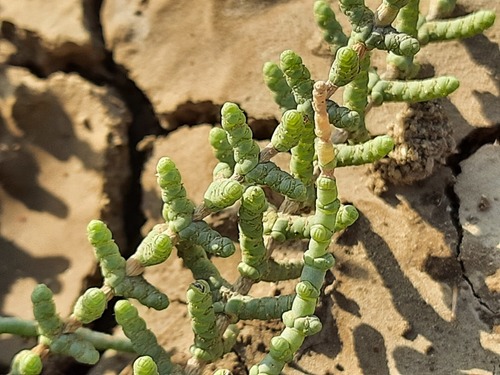
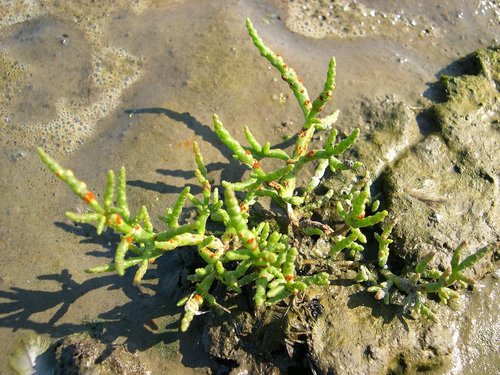
This species is scientifically known as Salicornia europaea (Moss) Lambinon & Vanderp., commonly called glasswort or samphire. Glasswort plants are relatively small, with jointed, bright green stems that turn red or purple during autumn. Their leaves are small and scale-like, and they produce fleshy fruits that each contain a single seed. Like most members of the subfamily Salicornioideae, Salicornia species use the C3 carbon fixation pathway to take in carbon dioxide from the surrounding atmosphere. It is found on most coastlines in Europe, growing in various zones of intertidal salt marshes, on beaches, and among mangroves. For cultivation, Salicornia prefers light, sandy, well-drained soil and a sunny position. Samphire can be planted out once the danger of frosts has passed. It is best watered with a saline solution of 1 teaspoon of sea salt in 1 imperial pint (0.57 L) of water, and grows best at 200 mM NaCl. In the Northern Hemisphere, harvesting of samphire shoots takes place from June to August; after this time, shoots become woody. Samphire should be managed as a slow-growing cut-and-come-again crop, with one month between each harvest. The ashes of glasswort, saltwort (called barilla), and kelp were long used as a source of soda ash, mainly sodium carbonate, for glassmaking and soapmaking. This plant-based source of soda ash was superseded in the first half of the 19th century by the introduction of the Leblanc process for industrial production of soda ash. Salicornia europaea is a new candidate plant species for effective phytoremediation of cadmium-contaminated saline soils.