About Alternanthera pungens Kunth
Taxonomic Classification
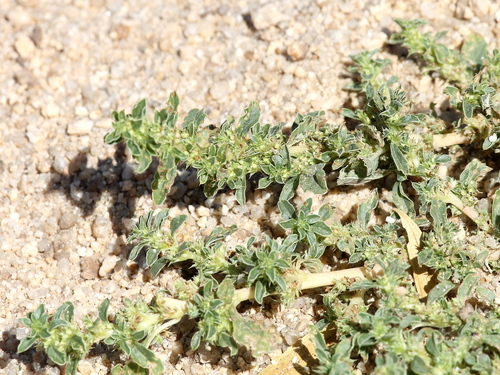
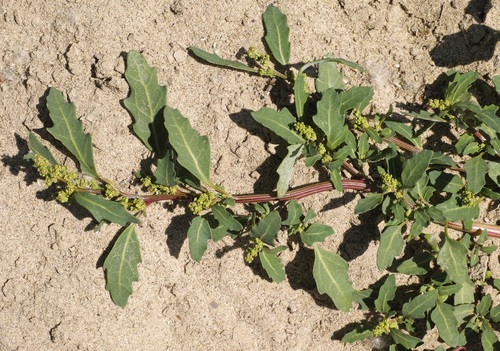
Alternanthera pungens Kunth is a creeping, prostrate perennial pioneer plant in the Amaranthaceae family.
Growth and Reproduction Methods
It spreads both by seed and vegetatively, and roots often develop at the nodes of its spreading stems.
Habitat Type
This is a ruderal species that grows on roadsides, path verges, and waste places.
Native and Introduced Range
It is thought to be native to Central and South America, and has become widely established in Australia and Southern Africa.
Congeneric Species Status
Other species in the Alternanthera genus, such as Alternanthera sessilis (L.) R.Br. ex DC., have been recorded from Tropical Africa for a long time, and it would be difficult to prove that these are invasive species.
Rainy Season Growth Form
During the rainy season, Alternanthera pungens forms dense mats of stems and leaves.
Dry Season Survival Adaptation
In the dry season or during drought, the above-ground plant material dies off, and the dormant plant is sustained by its fleshy taproot.
Flower Characteristics
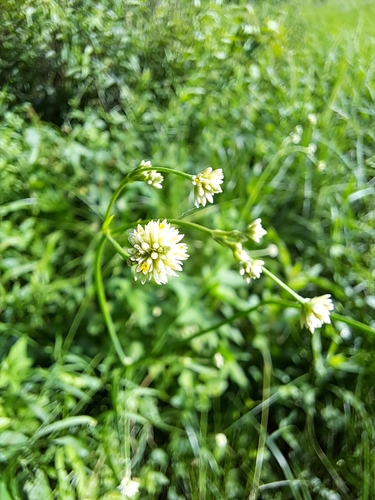
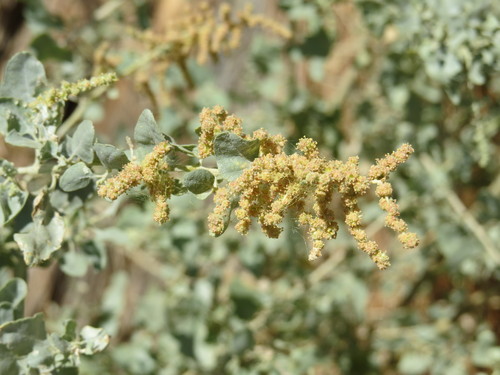
Clusters of small white flowers form in the leaf axils.
Fruit Characteristics and Dispersal
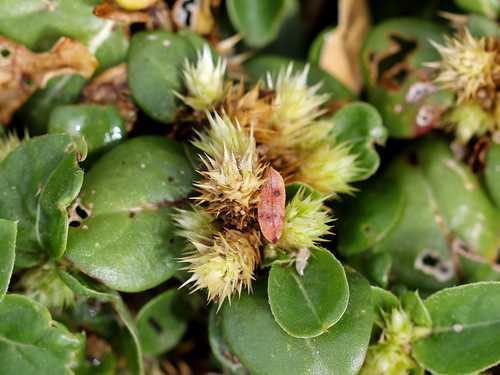
Its small, khaki-coloured, prickly, papery fruits are stemless, grow in the leaf axils, and are spread by livestock, vehicles, and livestock feed.
Seed Characteristics
The shiny seeds are brownish, compressed, lenticular, and measure about 1.5 mm across.
1732 Publication Record
This species was illustrated as early as 1732 by Johann Jacob Dillenius in his work Hortus Elthamensis, volume 1, where it was described as "Achyracantha repens foliis Bliti pallidi".
1836 Publication Record
It was illustrated again in 1836 by Jean-Christophe Heyland (1792-1866) in Histoire naturelle des Iles Canaries, volume 2(3): page 193, plate 199.
Genus Species Count
Kew currently recognizes 139 species in the genus Alternanthera.