About Russelia equisetiformis Schltdl. & Cham.
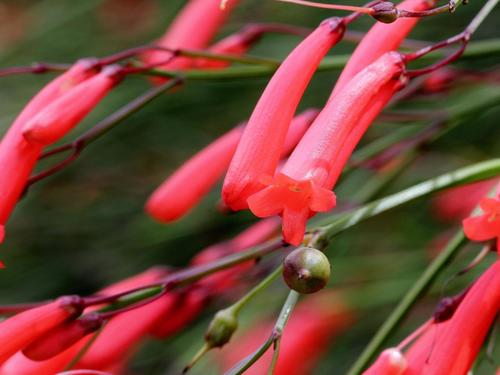
Russelia equisetiformis Schltdl. & Cham. is a multi-branching subshrub with thin leaves and arching foliage that reaches around 4–5 feet (1.2–1.5 m) in size. It forms a graceful, fountain-shaped mound, with bright green stems and tiny oval leaves. It flowers heavily, producing small, decumbent red flowers that give the plant its common name 'firecracker fern', because they create the impression of a bush on fire. It can bloom year-round in tropical and subtropical climates, such as USDA Hardiness zones 9-10 and warmer. Its long, trumpet-shaped flowers make R. equisetiformis popular with nectar-feeding birds and insects, and hummingbirds are especially attracted to it. Russelia equisetiformis is cultivated as an ornamental plant for subtropical and temperate gardens. In tropical locations, it is recommended for feature pots or hanging planters, because it can grow out of control in open garden settings. Cultivars are available in a range of colors including white, yellow, pale orange, and various shades of red. A minimum of 4 hours of sunlight per day provides optimal conditions for flowering. The firecracker plant can grow in a diverse range of growing conditions. This species grows best as a sprawling border or cascading groundcover, where its natural tufting, rush-like growth habit is highlighted. It is equally well-suited for growing as a feature plant in a container pot. It is especially attractive when grown in a hanging basket or hanging container, where it can cascade downwards. In this form it resembles cascading jungle cacti such as Hatiora or Rhipsalis, or the thin-leaved Hoya species Hoya linearis. Once established, R. equisetiformis is moderately drought tolerant. In temperate climates, this species is semi-deciduous. Different sources report different cold tolerance for the genus: one states it can withstand temperatures as low as −6 °C (21 °F), while other authorities claim it cannot tolerate temperatures below 5 °C (41 °F), cannot handle frost, and should be kept under glass or protected during the coldest months of the year. In colder climates, it can overwinter indoors as a houseplant if given access to direct sunlight or intense artificial lighting. In the United Kingdom, Russelia equisetiformis has been awarded the Royal Horticultural Society (RHS) Award of Garden Merit.