About Rumex longifolius DC.
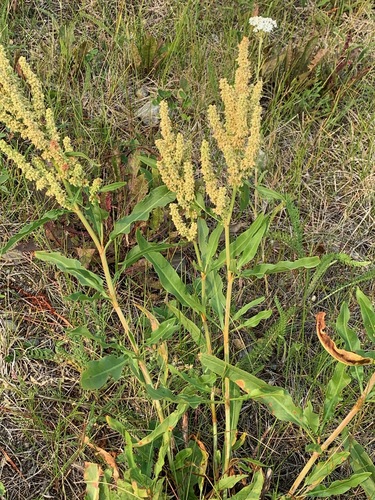
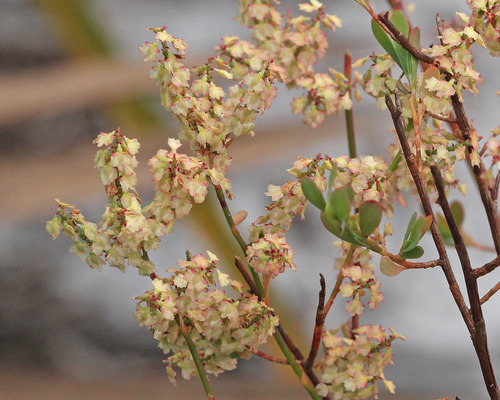
Rumex longifolius DC. is a perennial herb that reaches 60 to 120 cm (24 to 47 in) in height. It produces large, broad leaves with crinkled, undulating edges. The upper leaf surface is hairless, while the lower leaf surface is hairy alongside the veins. Its stems are erect, tough, and remain unbranched until just below the inflorescence. At stem nodes, two fused stipules form an ochrea: a thin, paper-like sheath that is a defining characteristic of the Polygonaceae family, and this sheath is fringed along its upper edge in R. longifolius. Stem leaves grow in an alternate arrangement, are narrowly ovate to lanceolate, and have a rounded or tapered base. Leaf stalks are roughly the same length as the leaf blade. The inflorescence is made up of large clusters of racemes, which hold small, greenish, bisexual flowers. Flower perianth segments are arranged in two whorls of three segments each. Outer whorl segments are small and spreading, while inner whorl segments develop into fruit valves that are rounded or kidney-shaped, with either smooth entire edges or crinkled edges. Each flower has six stamens, and a pistil formed from three fused carpels with three styles. The fruit is a glossy brown nut with a triangular cross-section. This species blooms from July through September. Rumex longifolius is native to Europe (including Britain), ranging from Scandinavia south and east to the Pyrenees, the Caucasus, and Western and Central Asia. It grows primarily in open habitats, including roadsides, arable fields, and damp grassy areas.