About Rostratula benghalensis (Linnaeus, 1758)
Taxonomy and Size
The greater painted-snipe, with the scientific name Rostratula benghalensis (Linnaeus, 1758), is a medium-sized shorebird that measures 23–28 cm (9.1–11.0 in) in total length.
Sexual Dimorphism
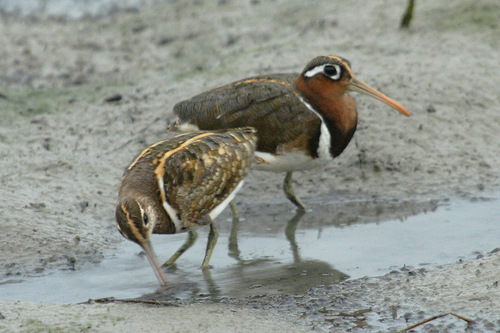
This species shows sexual dimorphism: females are larger, heavier, and have bolder plumage than males.
Female Plumage
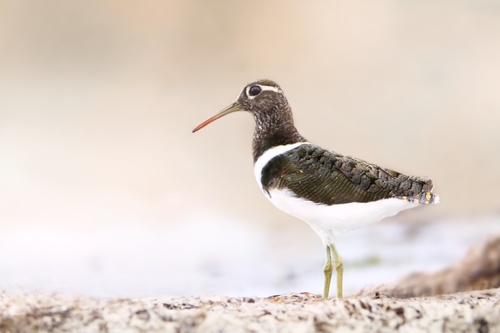
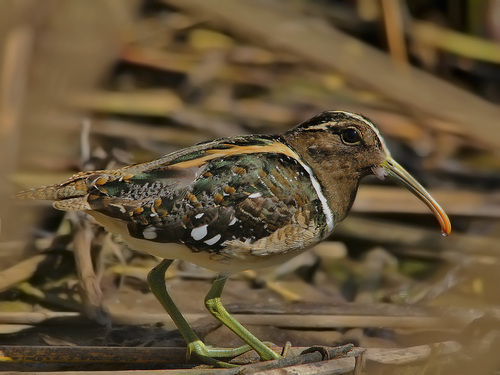
Females have a black head marked with a buff stripe and a white eye-patch. Their neck is dark rufous, and their upperparts are mostly dark bronze-green with fine black barring. A white stripe curves around the shoulder mantle, and the underbody is white.
Male and Juvenile Plumage
Males are much paler, less uniformly patterned, and have barring on the scapulars and wing-coverts. Juveniles resemble males but lack the darker band around the chest.
Vocalizations
This is not a vocal species; it is mostly silent outside of the breeding season. Breeding females may produce a "mellow hooting or booming" sound.
Global Distribution Range
Greater painted-snipe have a very wide distribution, occurring across mainland Africa, Madagascar, the Seychelles, India, and Southeast Asia.
African Distribution
In Africa, the species is found in the Nile River Valley and in non-rainforested areas of Sub-Saharan Africa. It is notably absent from eastern Somalia, the desert regions of Namibia, and parts of Botswana and South Africa.
Population Estimate
Despite its broad range, the species is uncommon across most of its distribution. According to BirdLife International, the global population holds between 31,000 and 1,000,000 mature individuals.
Wetland Habitat Preferences
Although greater painted-snipe live in a wide variety of wetland habitats, they prefer muddy areas with available vegetative cover. They also occur on the edges of lakes and rivers when cover is nearby, as well as in marshes and around swamps. They are most often found close to the edges of reed beds along the shorelines of marshes, swamps, ponds, and streams.
Diet Composition
Greater painted-snipe feed on insects, snails, earthworms, crustaceans, and vegetable matter such as plant seeds.
Foraging Behavior
They use a scythe-like movement of the head and bill when foraging in shallow water. They are generally crepuscular, feeding in the early morning and near dusk.