About Riccordia maugaeus (Audebert & Vieillot, 1801)
Common Name and Sexual Dimorphism
Riccordia maugaeus, commonly known as the Puerto Rican emerald, differs in size and appearance between males and females.
Body Length
Males are 8.5 to 9.5 cm (3.3 to 3.7 in) long, while females are 7.5 to 8.5 cm (3.0 to 3.3 in) long.
Weight
The entire species weighs between 3.4 and 3.8 g (0.12 and 0.13 oz).
Shared Facial Feature
Both sexes have a small white spot behind the eye.
Male Bill Structure
Males have a short straight bill, with a black-tipped red mandible and a black maxilla.
Male Head and Upperpart Coloration
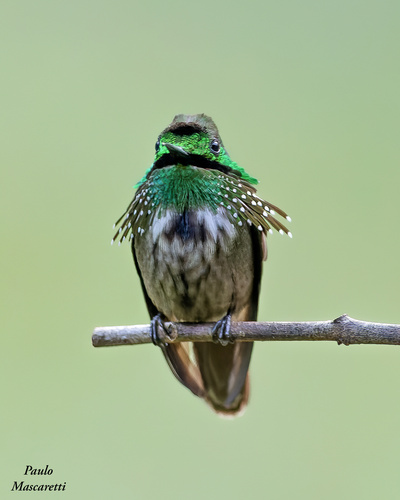
A male's forehead and crown are iridescent green, and the rest of its upperparts are dark shining metallic green.
Male Underpart Coloration
Its gorget is iridescent bluish green, and the rest of its underparts are shining green.
Male Tail Structure and Color
The male's tail is forked and colored shining steely blue.
Female Bill Structure
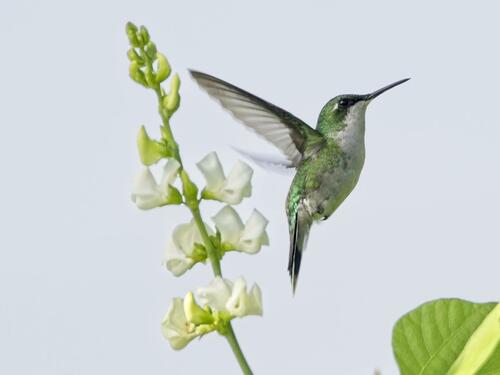
Females have an all-black bill.
Female Head and Upperpart Coloration
A female's forehead and crown are dull dark green, and the rest of its upperparts are shining grass green.
Female Underpart Coloration
Its throat is light gray, which darkens across the belly and undertail coverts.
Female Tail Fork Shape
The female's tail is less forked than the male's tail.
Female Outermost Tail Feathers
On the female's outermost pair of tail feathers, the bases are pale white, the centers are brown, and the ends are white.
Female Second Outermost Tail Feathers
The next pair of feathers moving inward is steel blue, with greenish white bases and a white spot at the end.
Female Intermediate Tail Feathers
The next two inward pairs are green on the half closest to the body, and dull brown on the outer half.
Female Central Tail Feathers
The central pair of tail feathers is shining green.
Species Distribution
The Puerto Rican emerald is distributed across the whole of Puerto Rico, its namesake island.
Forest Habitat Types
It lives in almost all forested landscapes, ranging from coastal mangroves to montane forest on island summits. This includes dry forests, moist forests, plantations, and secondary forest.
Modified Habitat Occurrence
It can also be found in gardens and urban areas.