About Rhinoptilus chalcopterus (Temminck, 1824)
Taxonomy and Morphology
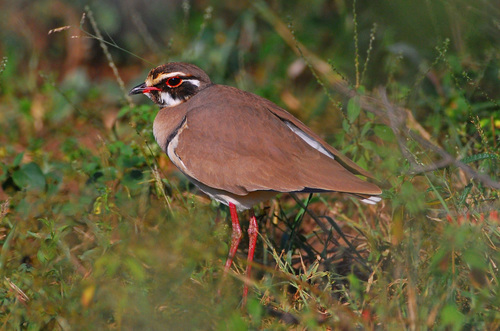
The bronze-winged courser, scientific name Rhinoptilus chalcopterus, is a small wading bird species with long legs and short wings.
Size Measurements
It is the largest of all coursers, with a body length of 25 to 29 centimeters, a maximum wingspan of 58 centimeters, and a body weight ranging from 91 to 220 grams.
General Distribution
This species occurs across parts of Sub-Saharan Africa, shifting its location on the continent with the seasons. It is believed to spend its breeding season in the southern portion of its range, then migrate north after breeding concludes.
Breeding Season Timing
Its breeding season runs from July to December.
Recorded Occurrences
Historical records confirm the species has been recorded at many localities throughout the year, including Eritrea, Nigeria, Ghana, Sudan, Kenya, the Democratic Republic of the Congo, Malawi, Botswana, Zambia, Zimbabwe, Gambia, and more recently Ethiopia.
Typical Habitat
The bronze-winged courser lives in semi-arid environments, most commonly dry savanna woodlands with dense brush. It is rarely found in open areas such as grasslands adjacent to wooded savannas.
Elevation Range
It generally occupies lower elevations, though it can be found at elevations as high as 2,350 meters. Breeding is thought to occur at lower elevations that do not typically exceed 1,700 meters.
Human-Related Threats
The bronze-winged courser is vulnerable to disturbance from human activities, especially habitat alteration caused by farming and other agricultural practices. Clearing of woodlands and its other preferred habitats reduces the amount of suitable habitat available to this species.
Natural Predators
It is also preyed on by other local birds, including the Bateleur and the Tawny Eagle.
Social Structure
The bronze-winged courser is a solitary species that forms monogamous pairs for breeding. Even when paired, breeding couples are territorial, and maintain a distance of at least 100 meters between adjacent nests.
Nesting Period
Breeding takes place during the dry season.
Nest Site Selection
Bronze-winged coursers usually choose nesting areas that have been affected by recent burns or fires. They typically do not build a true nest; instead, they clear a small nest-like spot that is no more than a 1 centimeter deep indentation in the ground. They nest in open sites with good visibility.
Clutch Characteristics
A clutch can contain up to 3 eggs, which have camouflage patterning that blends into the surrounding environment. This camouflage improves egg survival rates in the species' open nesting habitat.
Egg Camouflage Details
Egg camouflage varies in color and closely mimics the specific environment where the eggs are laid. Egg color ranges from cream to yellow, with accents of grey, sepia, reddish-brown, dark black, and even purple tones.
Egg Measurements
Eggs are small, measuring 33–40 millimeters long by 25–28 millimeters wide.
Incubation Behavior
Both parents incubate the eggs over a period of 25 to 27 days, and the pair alternates between sitting on the nest and standing watch nearby. If a predator approaches, the parents flee the nest and leave the eggs exposed.
Anti-Predator Nest Behavior
When threatened, bronze-winged coursers move at least 5 meters away from their nest.
Chick Rearing
After hatching, both sexes provide parental care to the chicks. The length of the chicks' fledging period is not currently known.
Chick Plumage
Newly hatched chicks have white plumage on their underside, and red-brown and black speckled plumage on their upper side.
Chick Morphology
Their legs are dark grey, and their bill is black.