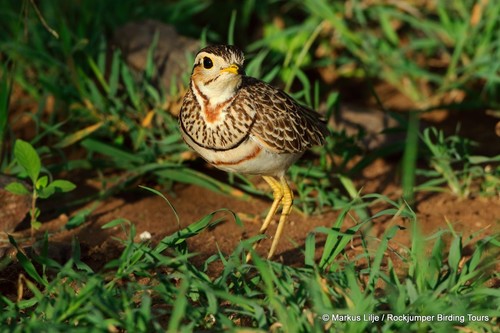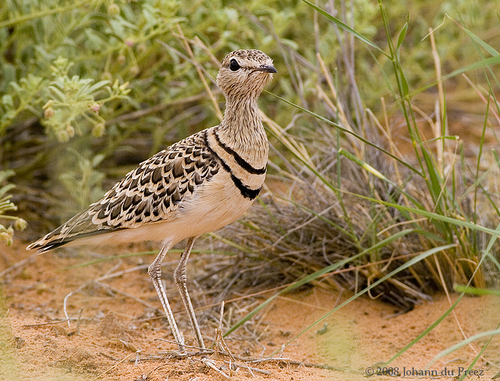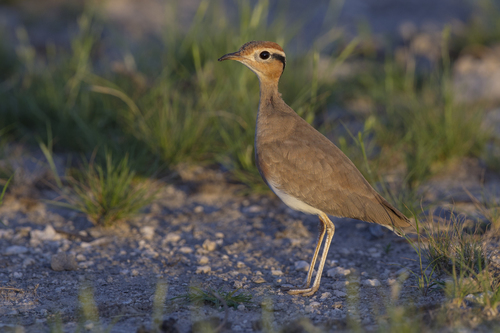
About Cursorius rufus Gould, 1837
Scientific Classification & Build
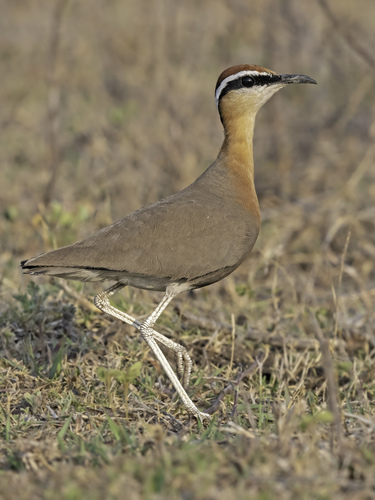
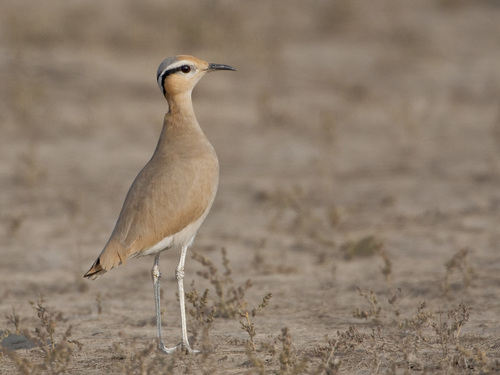
Burchell's courser (Cursorius rufus Gould, 1837) has a graceful build and an upright posture. Its key distinguishing feature from the similar Temminck's courser is a blue-grey hind crown. This species also has a horizontal black band that marks the edge of its white underbelly, and an overall pale rufous body color.
Facial Markings
On its face, white supercilia sit above black eye lines; both markings extend to the back of the neck and join to form a double V shape.
Feather Details
In terms of feather details, its secondaries are mostly white, it has a black underwing, and its coverts range from brown to grey.
Bill & Eye Features
As is typical for coursers, its bill is long, curves downward, and is dark, matching the color of its eyes.
Leg Coloration
Like its underbelly, its legs are a distinctive creamy white.
Flight Characteristics
When in flight, Burchell's courser's feet extend beyond the tip of its tail.
Adult Sexual Dimorphism
Adult females and males are similar in appearance.
Juvenile Appearance
Juveniles do not have the rufous coloring, facial stripes, and grey hind crown that adults have, and they have a mottled pattern with black and beige barring.
Camouflage Trait
Overall, Burchell's courser has a camouflaged appearance that helps it blend into the landscape, making it hard to spot.
Endemic Range
Burchell's courser is endemic to Africa, and favors warm, dry areas of Southern Africa. It can be found across most of South Africa and Namibia, as well as in parts of southwestern Angola and the Kalahari Basin region of Botswana. Its range occasionally overlaps with the range of Temminck's courser.
Habitat Preferences
This species inhabits gravel deserts and semi-deserts (rather than purely sandy desert areas), and also lives in open short-grass grasslands, and areas with sparse, burnt, or overgrazed vegetation.
Movement Patterns
It is described as locally nomadic based on its landscape-level movements, which may be driven by rainfall fluctuations.
Conservation Status
While Burchell's courser is classified as least concern, its population is declining.
Population Threats
This decline is potentially caused by habitat loss on arable land, inadequate farming practices including intense irrigation and overuse of pesticides, and other human-caused disturbances.