About Rhinanthus serotinus (Schönh. ex Halácsy & Heinr.Braun) Oborny
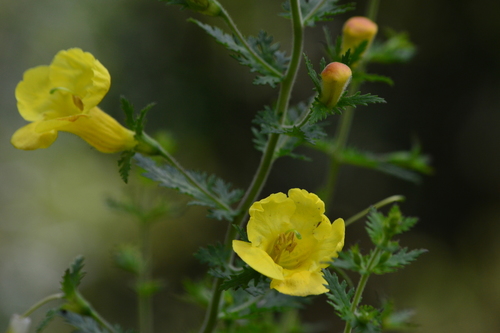
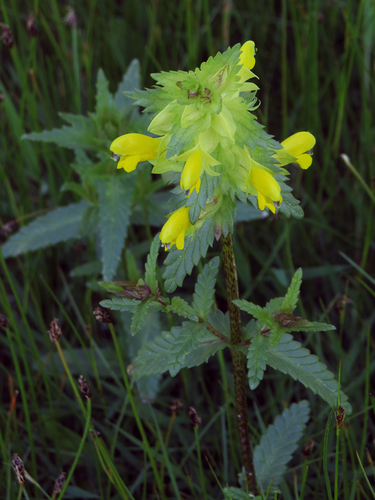
This species is commonly known as yellow rattle, a herbaceous annual hemiparasitic plant that resembles the larger greater yellow rattle (Rhinanthus angustifolius). It grows 10 to 50 centimetres (4 to 20 inches) tall. It bears opposite, simple leaves that measure 20–30 millimetres (0.8–1.2 in) by 5–8 millimetres (0.2–0.3 in). The leaves are sessile, meaning they grow directly from the stem, have a somewhat heart-shaped base, are ovate to lanceolate in overall shape, have toothed (dentate) margins, and are slightly rough (scabrid) to the touch. Its upright stem may be simple or branched, is four-angled, and often marked with black streaks or spots. Its yellow flowers are 13 to 15 millimetres (0.5 to 0.6 in) across and have a straight petal tube. Its fruit is a silvery dry capsule; when ripe, it holds loose seeds that rattle, a trait that gives the plant its common name. In 1652, herbalist Nicholas Culpeper wrote in The English Physician that yellow rattle was good for coughs and dimness of sight. The plant has a reputation for being toxic to animals. Its seeds contain bitter-tasting iridoids. Yellow rattle (Rhinanthus minor) is distributed across Europe, western Russia, western Siberia, the northern United States, and throughout Canada. It prefers dry fields or meadows, and can also grow well in semi-natural species-rich water-meadows. It flowers in summer from May to September. It tolerates a wide range of soil types, but will not grow in soil with a pH below 5.0. Its flowers are pollinated by bumblebees in summer, and the plant is also capable of self-fertilization. As a facultative hemiparasite, yellow rattle can obtain nutrients by penetrating the roots of neighboring green plants with its own roots, and acts opportunistically when in contact with a host root. This hemiparasitic habit can produce stunted, unbranched individual plants. It can associate with many different host species, most notably grasses (Poaceae) and legumes (Fabaceae). In Ireland and Scotland, it is frequently associated with Machair, a coastal grassland habitat. Traditional hay-making practices effectively spread its seeds. Farmers often seek to remove yellow rattle because it weakens grasses and reduces hay yields, and it is considered an indicator of poor grassland. Yellow rattle is used to create or restore wildflower meadows. It is deployed to reduce the dominance of grasses when more expensive approaches like removing nutrient-rich topsoil, or impractical approaches like adjusting grazing timing and intensity, are not usable. Reducing grass dominance improves the chance that other wildflower species will successfully establish. According to Natural England, the optimal density of yellow rattle to support the introduction of other species is 100 to 200 plants per square meter. Studies show the plant maintains species diversity through differential growth suppression of dominant plants and enhanced soil nutrient recycling. To establish yellow rattle, seed is sown thinly onto grassland where gaps have been created, or where all existing grass has been cut back and clippings removed. Seeds can also be introduced by spreading green hay. Existing grass should be kept short until early March, when seedlings finish establishing. After yellow rattle plants germinate and mature, their fruits shed seeds. The meadow hay is then cut and removed to encourage growth of the introduced wild flowers. Yellow rattle seed is short-lived, so it is sown in autumn using seed harvested the same year. The seeds must remain on or below ground through the cold winter months to germinate the following spring.