About Recurvirostra avosetta Linnaeus, 1758
Adult Plumage Coloration
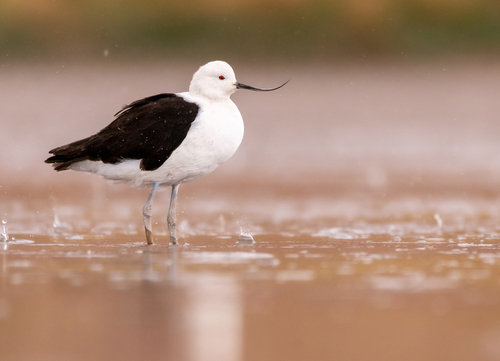
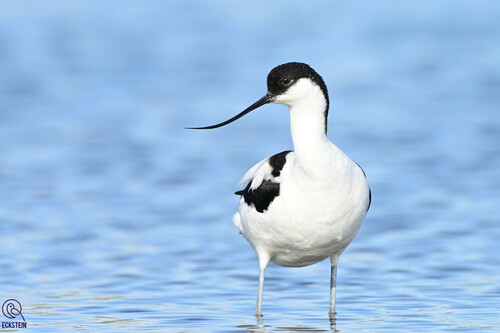
Description: Adult Recurvirostra avosetta have a striking black-and-white plumage, with a black cap that extends to the back of the neck. Their primaries are black, with the base of the inner primaries being white, while the secondary coverts are dark grey.
Tail Feather Coloration
The central rectrices are pale grey-brown, and all other rectrices are white. This species has no seasonal variation in plumage.
Extremity Coloration
The tail is white, and the legs are bluish. The long, slender black beak is upturned.
Sexual Dimorphism Overview
Sexual dimorphism is subtle and hard to distinguish in the field. Males have longer bills that are less curved, while females have shorter bills with more distinct curvature.
Female Plumage Markings
The black markings on the female's head may occasionally look browner and less defined.
Adult Size and Iris Color
Males are generally larger than females, and have a red or reddish-brown iris, while females have a hazel-brown iris.
Flight Appearance
In flight, the wingtips and shoulders are black, and the legs extend beyond the tail.
Chick Down Coloration
Chicks are covered in pale grey-brown down that is finely speckled with black. They have black patterns on the head, four rows of black spots on the back, and a white underbelly with a yellowish tinge on the neck and belly.
Chick Iris Color
Their iris is dark brown.
Juvenile Plumage and Legs
Juveniles have dingy grey wing coverts, with back and scapular feathers that are vermiculated with reddish-brown. Their legs are greyish.
First Summer Juvenile Plumage
By their first summer, the juveniles' primaries become very worn and brownish. After their first moult, which is completed by late September, juveniles resemble adults.
Moult Schedule
This species undergoes two moults each year: a partial moult in February to March before breeding, and a complete moult after breeding, from July to October.
Distribution Overview
Distribution: The pied avocet, Recurvirostra avosetta, is a Turano-Mediterranean species found in the Palearctic. Its fragmented range stretches across European coastlines from southern Scandinavia and the Baltic states (for example, it has been present in Estonia since 1964) to the Iberian Peninsula, the Mediterranean, the Black Sea, and the eastern European plains including Ukraine, Bulgaria, Romania, and Hungary.
Major European Populations
Major European populations are located in the Netherlands, Germany, Denmark, Spain (southern Spain and the Ebro Delta), Italy (the Po Delta and Sardinia), France, and Russia.
United Kingdom Breeding Population
It occurs on southern English coasts, with approximately 150 pairs recorded in 1979, after returning to breed in 1947 at Suffolk’s Minsmere RSPB reserve, having disappeared from the area in the mid-19th century.
Asian Distribution
In Asia, its range extends from Turkey (Anatolia) to northern Mongolia, northern China, the southern Russian Far East, Kazakhstan, and Middle Eastern countries including Iran, Iraq, and Jordan. It has a patchy distribution in the Gulf states, Pakistan, and the Indian subcontinent.
African Distribution
In Africa, it occurs along the Mediterranean coast of North Africa, the Red Sea, and the Atlantic coast down to Senegal and northern Guinea, and covers parts of the Sahel, East Africa, and southern Africa.
Migratory Population Ranges
Northern European populations ranging from the Netherlands to Scandinavia and eastern Asian populations are migratory. Western European birds winter in West Africa (Senegal, Gambia, Niger) and Mediterranean countries, especially Spain and Portugal, which host around one-third of all migratory European pied avocets.
Eastern European Wintering Grounds
Eastern European birds winter in Niger, Chad, Sudan, and the Red Sea. Some individuals overwinter in areas from Denmark to the Netherlands, and England to Ireland.
Asian Wintering Grounds
Asian populations winter in East Africa or the Indian subcontinent.
Migrant Group Timing
Migratory groups numbering 5 to 30 birds move between August and October, and return to breeding grounds between March and May.
Sedentary Populations
Mediterranean, some African, and Gulf populations are sedentary. Some birds from the Camargue winter in Morocco and Tunisia.
Rare Sightings
Transalpine flights during migration have been recorded, for example in Engadine, but inland sightings are rare. Individual pied avocets have been recorded as far from the core range as the Faroe Islands, Azores, and Canary Islands.