About Recurvirostra americana J.F.Gmelin, 1789
Taxonomic Identification and Size
The American avocet (Recurvirostra americana J.F.Gmelin, 1789) measures 40–51 cm (16–20 in) in length, has a 68–76 cm (27–30 in) wingspan, and weighs 275–420 g (9.7–14.8 oz).
Bill Morphology
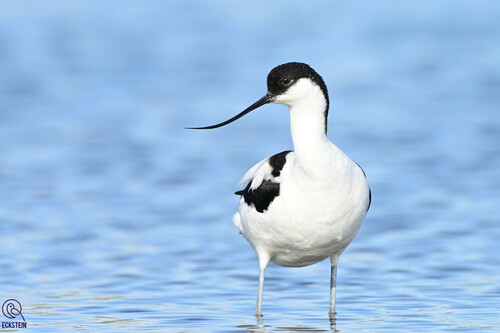
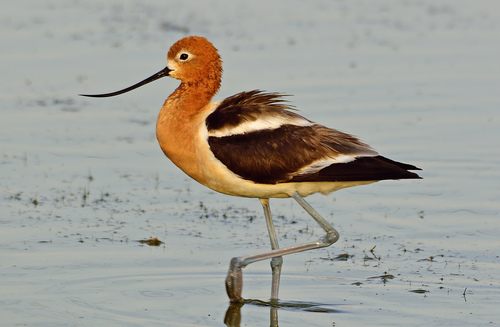
Its bill is black, pointed, and slightly curved upward toward the tip. The bill is long, more than twice the length of the species' small, rounded head.
Leg and Foot Characteristics
Like many waders, the American avocet has long, slender legs and slightly webbed feet. Its legs are pastel grey-blue, which gives the species its colloquial name "blue shanks".
Non-breeding Plumage
Its back plumage is black and white, and its underbelly is white.
Breeding Plumage
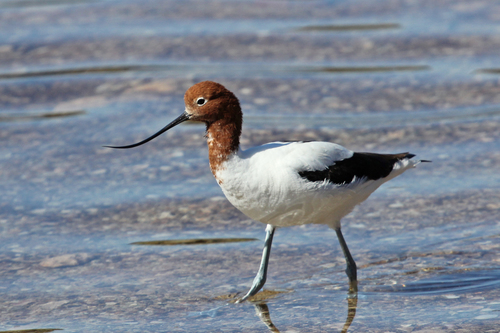
During the breeding season, the head and neck (and part of the upper breast) are colored brassy orange. After the breeding season, these bright feathers are molted to white and grey.
Preening Behavior
American avocets preen their feathers, a behavior commonly classified as a comfort movement.
General Call Description
The species' call has been described as both a shrill and melodic alarm bweet that rises in inflection over time. Avocets produce three distinct calls: a common call, an excited call, and a broken wing call.
Common Call
The common call is a loud, repeated wheep.
Excited Call
The excited call has a similar wheep sound, but speeds up instead of having an even rhythm.
Broken Wing Call
The broken wing call is noticeably different from the other two: it is a distressed screech, and sounds alarming rather than melodic.
Historical Range
Historically, American avocets ranged across most of the United States before they were extirpated from the East Coast.
Breeding Habitat and Range
Their breeding habitat includes marshes, beaches, prairie ponds, and shallow lakes in the midwestern United States, extending as far north as southern Canada. Most breeding grounds lie just east of the Rocky Mountains, covering parts of Alberta, Saskatchewan, Montana, Idaho, Washington, Utah, North Dakota, South Dakota, Nebraska, Colorado, and extending south into parts of New Mexico, Oklahoma, and Texas.
Migration Range
During migration, the species passes through almost every state in the western United States.
Wintering Range Overview
Wintering grounds for the American avocet are mainly coastal.
Atlantic Wintering Range
Along the Atlantic Ocean, they occur in North Carolina, South Carolina, Georgia, and Florida.
Gulf and Pacific Wintering Range
They also winter along the Gulf of Mexico in Florida, Texas, and Mexico, and along the Pacific Ocean in California and Mexico.
Resident Populations
Resident populations are found in central California and the Mexican states of Zacatecas, San Luis Potosí, Guanajuato, Hidalgo, Mexico City, and Puebla.
Spring Migration Behavior
During peak spring migration, which typically peaks around April or May, flocks of 50 to 300 avocets migrate together to breeding sites.
Foraging Habitat Preference
American avocets prefer foraging habitats with fine sediments.
Winter Diet
In winter, they feed extensively on brine shrimp.
Foraging Movement Methods
Foraging usually involves pecking while walking or wading along the shore, but the species can also swim to expand its foraging range.
Breeding Season Diet
During the breeding season, avocets still eat brine shrimp but switch their main diet to brine flies. Brine flies and their larvae are so abundant on avocet breeding grounds that they often blacken the surface of exposed mud, and provide the main food source for avocets throughout the breeding season.
Feeding Method Categories
American avocets use both visual and tactile feeding methods.
Visual Feeding Methods
The primary visual feeding method is pecking at flies. They also feed by plunging (submerging the head and neck), snatching (catching flying insects), and bill pursuit (repeatedly opening and closing the bill while moving the head along the water surface).
Tactile Feeding Methods
Tactile feeding methods include filtering, scraping, and scythe feeding.