About Ranunculus repens L.
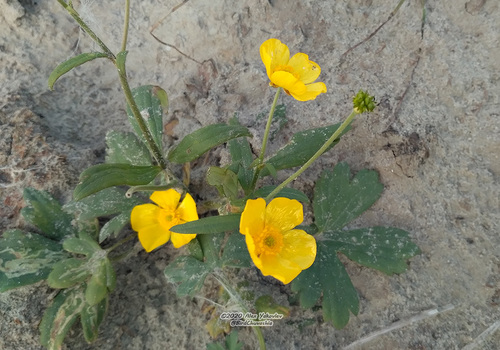
Ranunculus repens L., commonly called creeping buttercup, is a stoloniferous herbaceous perennial plant that reaches up to 50 cm (20 in) in height. It produces two types of stems: prostrate running stems that grow along the ground, rooting and forming new plants at the nodes, and more or less upright flowering stems.
Basal Leaf Traits
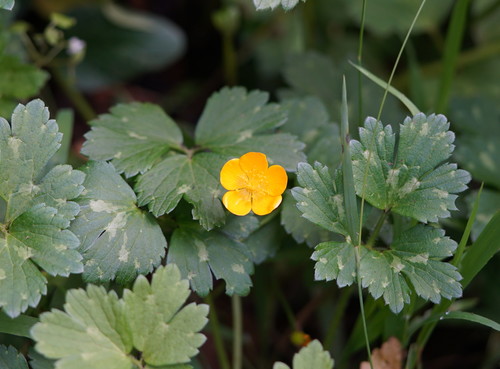
The plant's basal leaves are compound, growing on petioles 4–20 cm (1+1⁄2–8 in) long. These leaves are divided into three broad leaflets, which measure 1.5–8 cm (1⁄2–3+1⁄4 in) long and range from shallowly to deeply lobed.
Species Distinguishing Feature
All three leaflets are stalked, a trait that distinguishes this species from Ranunculus acris, where the terminal leaflet is sessile.
Upper Stem Foliage
Leaves growing higher up the stems are smaller, with narrower leaflets, and may be simple and lanceolate. Both stems and leaves are covered in fine hairs.
Flower Appearance
Flowers of Ranunculus repens are golden yellow, glossy, and 2–3 cm (3⁄4–1+1⁄4 in) in diameter, most often with five petals. The flower stem has fine grooves along its length.
Petal Gloss Function
The glossy sheen on the flowers comes from a smooth upper petal surface that acts like a mirror; this gloss helps attract pollinating insects and supports thermoregulation of the flower's reproductive organs.
Fruit and Vegetative Traits
After flowering, the plant produces a cluster of achenes 2.5–4 mm (3⁄32–5⁄32 in) long. Creeping buttercup has three-lobed dark green leaves marked with white spots that grow out from nodes.
Native Habitat Preference
It grows naturally in fields and pastures, and prefers wet soil.
Weed Status
As a habitat generalist, it is an extremely common weed of agricultural land and gardens. It spreads quickly via its rooting stolons, and is hard to remove thanks to its deeply anchored filamentous root ball.
Irish Distribution
In Ireland, it is very common in damp locations, ditches, and flooded areas.
Invasive Classification
Creeping buttercup was sold as an ornamental plant across many regions of the world, and is now classified as an invasive species in many of those areas.
Toxicity Properties
Like most buttercup species, Ranunculus repens is poisonous, but its toxic compounds break down and are lost when the plant is dried for hay. Buttercups have an acrid, bitter taste, so cattle avoid eating them.
Spread Mechanisms
This allows creeping buttercup to take advantage of grazed, cropped ground around it to spread its stolons. The plant is also spread to new areas via the transportation of hay.
Skin Contact Effect
Direct contact with the plant's sap can cause skin blistering.