About Ranunculus lanuginosus L.
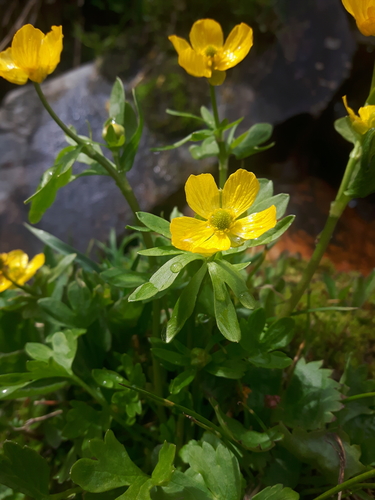
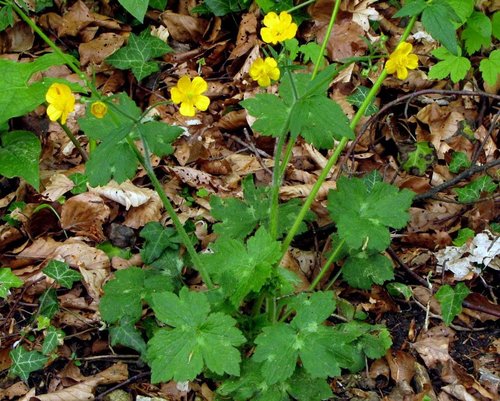
Ranunculus lanuginosus L., commonly known as woolly buttercup, is a herbaceous perennial buttercup species that grows 30 to 80 centimeters tall. It typically grows upright and spreads out, with a thick, round, hollow stem covered in a dense layer of trichomes. Its basal leaves have long leafstalks and are palmately lobed, with five ovate, hirsute segments that have double serrated margins. Upper stem leaves are sessile, palmately lobed, and have wide segments. Most leaves measure 12 centimeters long and 8 centimeters wide. This species is entomophilous, and flowers from May to August. Its flowers are yellow to orange with a darker central area, with five floral parts in both the corolla and calyx. Individual flowers are 2 to 2.5 centimeters across, and the calyx is made up of hairy sepals. The fruit of this plant is a hairless achene that is flattened laterally and ends in a long, curved rostrum. Like many other buttercups, woolly buttercup is toxic. This species is native to Europe and the Caucasus, occurring in central and southern Europe, the Caucasus, and is native to Albania, Austria, the Baltic States, Bulgaria, Corsica, Czechoslovakia, Denmark, France, Germany, Greece, Hungary, Italy, Poland, Romania, Sardinia, Sicily, Switzerland, European Turkey, Ukraine, and former Yugoslavian countries. It is a relatively common species that grows in various shaded forests with dense undergrowth, as well as other similar shaded, humid habitats. It is classified as a hemicryptophyte under the Raunkiær system. It is primarily a lowland species, and only rarely grows in the subalpine zone, reaching a maximum elevation of around 1,400 meters.