About Ranunculus flabellaris Raf. ex Bigelow
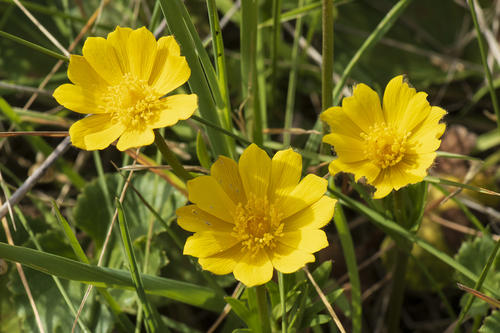
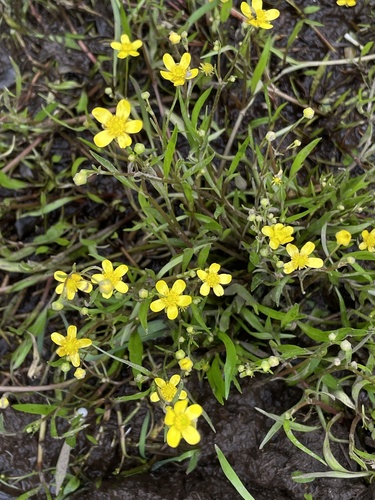
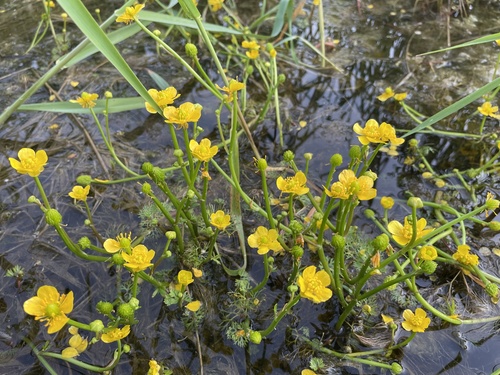
Ranunculus flabellaris is a species of flowering plant in the buttercup genus Ranunculus, with the common names yellow water buttercup and yellow water crowfoot. It is native to most of North America, covering the southern half of Canada and most of the United States. This is an aquatic or semi-aquatic perennial herb that grows in water, within or adjacent to muddy areas across many habitat types. It produces stems up to roughly 70 centimeters long, which either float in water or spread across wet ground, and sometimes root when they touch moist substrate. Its leaf morphology is variable: like many aquatic plants, Ranunculus flabellaris produces different leaves when they grow submerged in water versus when they grow in open air. This trait, called heterophylly, has been widely studied in this species, and research shows leaf morphology is affected by many environmental factors, including temperature and abscisic acid concentration. A number of other factors also impact leaf shape in these heterophyllous plants. For this specific species, leaves that grow in open air have somewhat rounded blades divided into multiple short, blunt, wide lobes. Leaves that grow underwater have narrow, even threadlike lobes. The inflorescence holds one or more flowers that have between five and fourteen shiny yellow petals, most often no more than eight. Each petal can grow up to 1.3 centimeters long, and petals are arranged around a central nectary surrounded by many stamens and pistils. The fruit produced by this species is an achene that develops in a dense cluster.