About Ranunculus cortusifolius Willd.
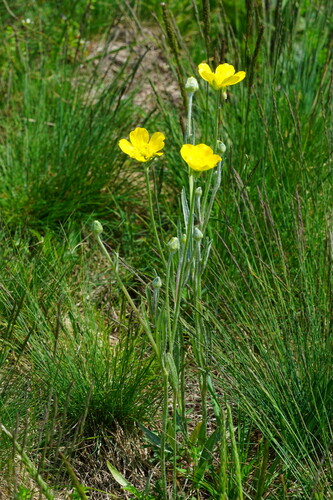
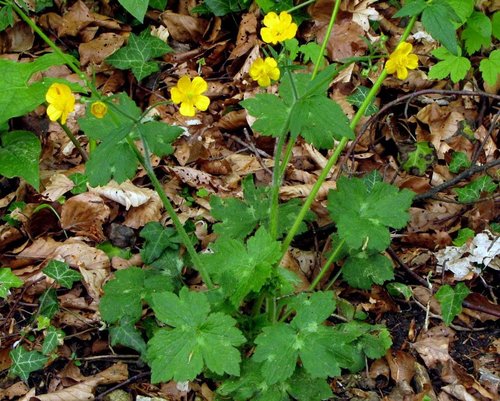
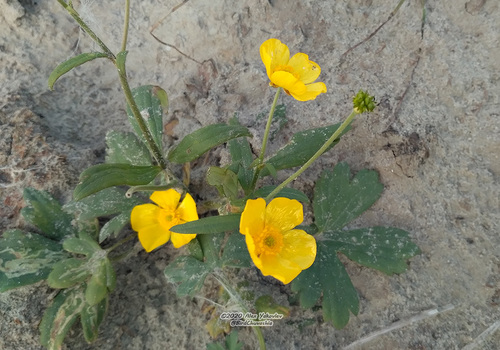
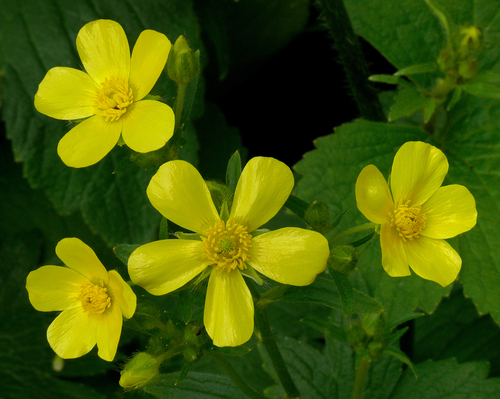
Ranunculus cortusifolius Willd. is a plant with palmate lobed leaves and showy yellow flowers. Its root is grumose, formed from thick, fleshy, fascicled fibers. The stem grows 2 to 4 feet high, is terete, and along with all foliage is covered in rather pilose hairs that are dilated at the base. Radical leaves grow on long hairy petioles, are large, and shaped between orbicular and reniform, with 3 to 5 lobes. The lobes are further divided and cut into several acute lobules or large sharp teeth, which are themselves cut and serrated; the whole leaf has somewhat radiate and dichotomous venation. Upper leaves gradually decrease in size, are sessile, and split into 5 to 3 segments; the segments are lanceolate, coarsely serrated, and have parallel veins. Flowers are terminal, arranged in a form between cymose and paniculate. Petioles are terete. The calyx consists of five ovato-lanceolate, very hairy, herbaceous sepals that are pale and scariose at the margin. There are five large, broadly obovate, very glossy yellow petals. Stamens are very numerous. The head of pistils is short and oval. The ovary is round-ovate, compressed, hairy laterally, and tapers into a recurved style that is scarcely as long as the ovary itself. The head of fruit is shaped similarly to the head of pistils, but larger. Interspecific hybridization occurs between Ranunculus cortusifolius and Ranunculus asiaticus. Hybrids produced from this cross, which is done to select for multiple flowering habit, are not available for commercial purposes. This species is similar to butterfly Ranunculus.