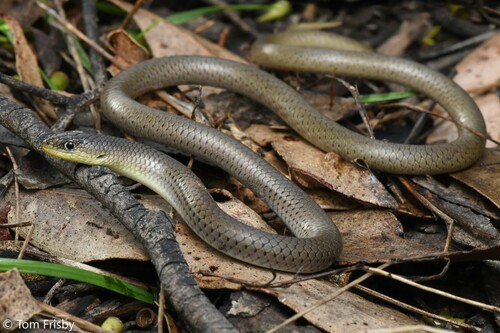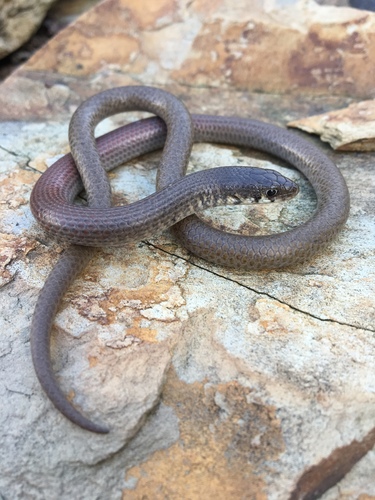
About Pygopus schraderi Boulenger, 1913
Taxonomic Classification
The eastern hooded scaly-foot (Pygopus schraderi) is the second smallest species in the genus Pygopus.
Size Characteristics
It reaches a maximum snout-vent length of 198mm, and can grow to a total body length of up to 475mm, with females growing larger than males.
Tail Proportion
More than three-quarters of this species' total body length is made up by its tail.
Tail Autotomy
When threatened, eastern hooded scaly-foots will readily shed their tails, and can regrow lost tails, meaning their tails may sometimes be shorter than their body.
Regrown Tail Identification
A regrowing tail can be identified by an abrupt change in pattern and scale arrangement.
Base Body Coloration
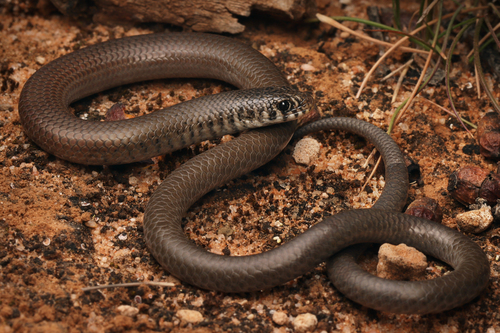
Upper body markings on these lizards range from reddish-brown to pale grey, while their underside is whitish.
Head Markings
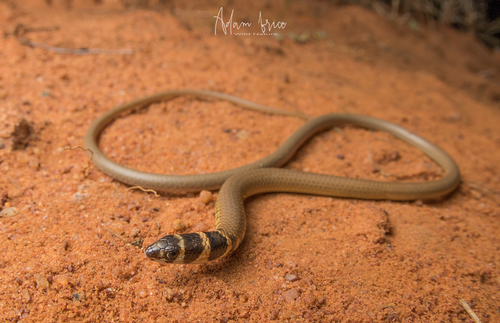
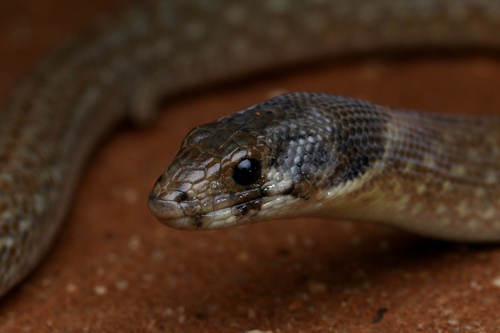
Symmetrical dark brown to black scales on the top of the lizard's head create a 'hooded appearance'.
Head Pattern Significance
These head markings closely resemble those of young brown snakes (Pseudonaja spp.), though it is not known if this similarity is a result of direct mimicry, or if the pattern functions to help regulate temperature.
Scale Edge Pattern
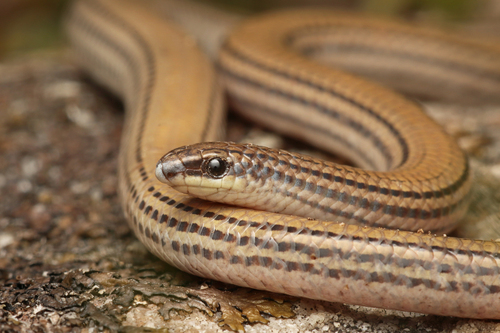
The species' body scales may have dark edges, which form an overall reticulated or net-like pattern.
Body Marking Variations
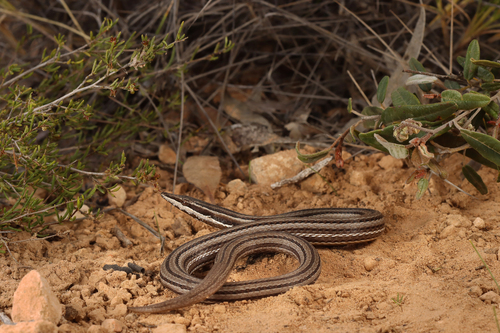
Individual paler and darker scales can form distinct but irregular V-shaped cross-bands, or sometimes broken longitudinal lines or stripes, most noticeably on the flanks.
Marking Fading in Larger Individuals
All of these markings are still present in larger individuals, though they are sometimes only faint.
Mid-Body Scale Arrangement
This species has keeled scales, with body scales arranged in 21 to 25 rows (including ventral scales) at mid-body.
Ventral Scale and Nostril Features
The eastern hooded scaly-foot has fewer than 120 ventral scales, which are noticeably wider than its adjacent body scales, and its nostril is positioned on the first upper labial scale.
Overall Geographic Distribution
The eastern hooded scaly-foot is distributed across inland New South Wales, Victoria, eastern South Australia, inland Queensland, and adjacent parts of the Northern Territory.
Habitat Type
It occurs in dry to arid zones across a range of open habitats, including stony plains, dry woodlands, arid mallee, mulga scrubs, and spinifex-dominated desert grasslands.
Soil and Territory Preferences
It prefers stony and heavy soils, and depends on large, interconnected territories.
Sheltering Behavior
Because it cannot sustain or rapidly recover from aerobic activity, this species shelters to avoid predation in soil cracks, grass, under debris, and in large burrows.
New South Wales Distribution
In New South Wales, the eastern hooded scaly-foot is rare in the NSW Murray Catchment, but occurs in areas that support native grasslands and grassy woodlands, particularly in the region bordering the Murrumbidgee Catchment to the north.
Victoria Distribution
Within Victoria, the eastern hooded scaly-foot is rarely encountered, and is only known to exist at six sites: Terrick Terrick National Park, Korrack Korrack grasslands, and areas west of Mildura including Lake Ranfurly and Neds Corner Station.
Reproductive Mode
The eastern hooded scaly-foot is oviparous.
Clutch Characteristics
It lays a clutch of two eggs once per year in spring or early summer, though clutches may occasionally be one or three eggs.
Breeding Season
Breeding occurs from August to March.
Gestation and Incubation
Pregnant females have been recorded in January and February, and incubation periods range from 66 to 77 days.
Communal Egg Laying
Species in the genus Pygopus have been observed laying eggs communally.
Captive Courtship Observation
In captivity, few courtship or mating displays have been observed.
Mating Behavior
Males will follow females while repeatedly flicking their tongue.
Male Mating Adaptations
Pelvic spurs, which are modified spine-like scales, and hind-limb 'flaps' on males are thought to help males grip females during mating.