About Pultenaea tenuifolia R.Br.
Taxonomic Identity and Growth Habit
Pultenaea tenuifolia R.Br. is a spreading, low-lying to prostrate, mat-forming shrub, which typically grows up to 1 metre (3 feet 3 inches) tall. It has hairy branches that can reach up to 1 metre (3 feet 3 inches) in length.
Leaf Morphology
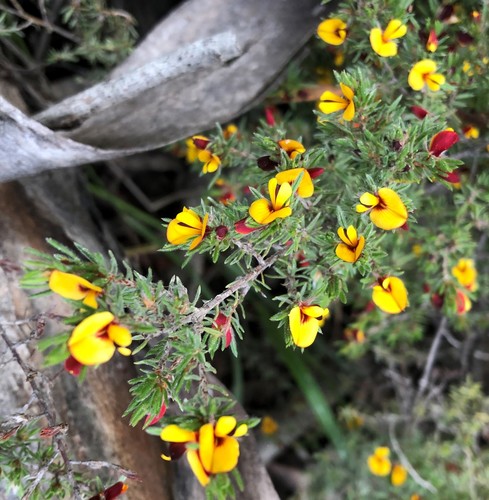
Its leaves are narrow lance-shaped, mostly 4–8 mm (0.16–0.31 in) long and 0.3–0.5 mm (0.012–0.020 in) wide, with 2–3 mm (0.079–0.118 in) long stipules at the base. The upper surface of the leaves is channelled, and the leaves are often clustered.
Flower Arrangement
The flowers are 5–8 mm (0.20–0.31 in) long, sessile, and arranged singly or in pairs at the ends of short side-branches, where they are surrounded by clustered leaves.
Sepal Characteristics
The sepals are 4–5 mm (0.16–0.20 in) long and joined at the base, with hairy egg-shaped to oblong lobes, and 3 mm (0.12 in) long bracteoles at the base.
Petal Coloration
Petals range in color from yellow to orange and red.
Petal Morphology
The standard petal is 4.5–8 mm (0.18–0.31 in) wide, the wings are oblong to egg-shaped and 4.0–6.7 mm (0.16–0.26 in) long, and the keel is semi-circular and 4–6 mm (0.16–0.24 in) long.
Flowering Period and Fruit
Flowering takes place from August to December, and the fruit is a hairy, egg-shaped pod.
Common Name and Broad Distribution
This species, commonly called slender bush-pea, is distributed across Western Australia, South Australia, Victoria and Tasmania.
Western Australia Distribution
In Western Australia, it grows in near-coastal areas within the Esperance Plains, Jarrah Forest and Warren biogeographic regions.
South Australia Distribution
In South Australia, it occurs from the Eyre Peninsula to the Victorian border.
Victoria Habitat
In Victoria, it grows on coastal sand dunes and in the calcareous soils of the Little and Big Deserts.
Tasmania Habitat
In north-eastern Tasmania, this species is found growing on granite.