About Pultenaea hispidula R.Br. ex Benth.
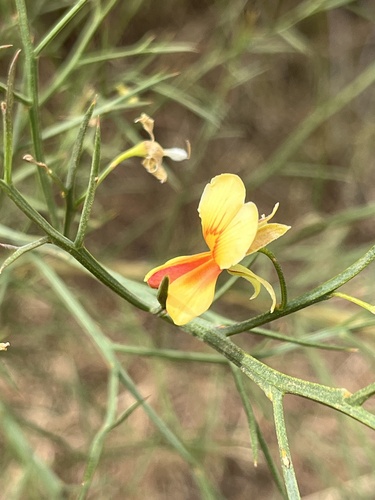
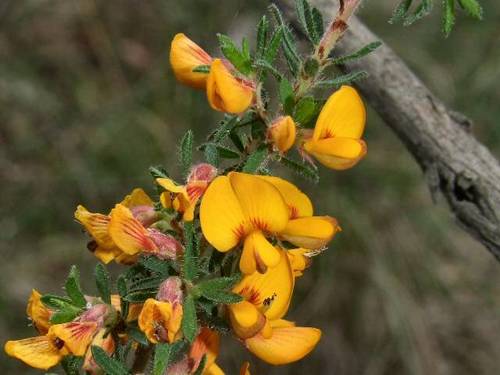
Pultenaea hispidula, commonly known as rusty bush-pea, is an erect, spreading shrub with many drooping, densely hairy branches. It typically reaches a height of around 1 metre (3 feet 3 inches). Its leaves are oblong to egg-shaped, with the narrower end positioned toward the base, measuring 4–8 mm (0.16–0.31 in) long and 0.7–3 mm (0.028–0.118 in) wide. Lance-shaped stipules 1–2 mm (0.039–0.079 in) long grow at the base of each leaf. Flowers are arranged in dense clusters in leaf axils, near the ends of short side branches. Each flower is 5–8 mm (0.20–0.31 in) long, growing on a 1–2 mm (0.039–0.079 in) long pedicel. Broadly egg-shaped to narrow lance-shaped bracteoles 2.5–4 mm (0.098–0.157 in) long attach near the base of the sepal tube. The sepals are 3–5.5 mm (0.12–0.22 in) long. The standard petal is yellow to pale orange with red markings on its back, and is 6–10 mm (0.24–0.39 in) wide; the wing petals are yellow, and the keel is red or crimson. Flowering takes place from August to December. The fruit is an egg-shaped pod 4–5 mm (0.16–0.20 in) long. This species grows in forest, and sometimes in heath. It occurs in coastal New South Wales south from the Hawkesbury River, in Victoria south of the Great Dividing Range, and in the southeast of South Australia.