About Lupinus angustiflorus Eastw.
Nomenclature
Lupinus angustiflorus Eastw. is a species of lupine commonly called narrowflower lupine.
Distribution
It is endemic to California, where it grows in the volcanic soils of the northeastern mountains and Modoc Plateau, and is native to the contiguous 48 United States.
Growth Form
This plant is an erect perennial herb that sometimes grows over one meter tall.
Leaf Structure
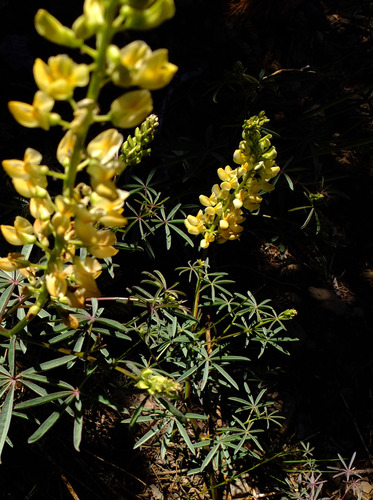
Each palmate leaf consists of 6 to 9 leaflets, each of which can reach up to 6 centimeters in length.
Inflorescence Characteristics
Its inflorescence can grow up to 34 centimeters long, and holds many flowers that are each roughly one centimeter long.
Flower Coloration
Flowers range in color from cream to pale yellow-orange, with a patch of deeper yellow or orange on the banner (the uppermost petal).
Petal Details
The keeled lower petals may have lavender tips.
Fruit Characteristics
The fruit is a hairy legume pod that can grow up to 4 centimeters long.
Plant Texture
The whole plant ranges from hairless (glabrous) to hairy in texture.