About Pultenaea daphnoides J.C.Wendl.
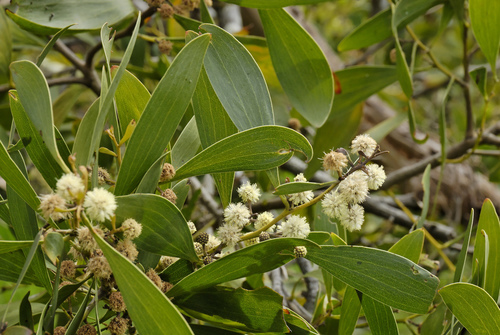
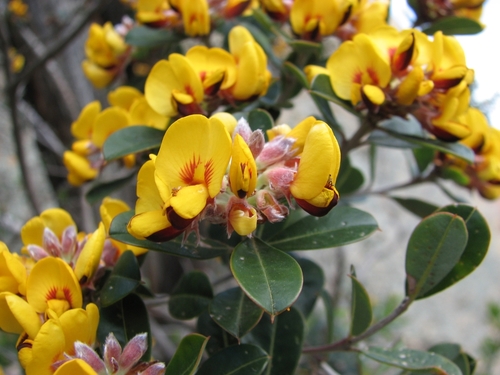
Pultenaea daphnoides J.C.Wendl., commonly called large-leaf bush-pea, is an erect shrub that typically grows 1 to 3 meters (3 feet 3 inches to 9 feet 10 inches) tall. It has hairy, four-angled stems. Its leaves are wedge-shaped to egg-shaped with the narrower end toward the base, 5 to 40 millimeters (0.20 to 1.57 inches) long and 2 to 11 millimeters (0.079 to 0.433 inches) wide. Each leaf has a pointed tip and 1 to 2 millimeter (0.039 to 0.079 inch) long stipules at its base. The flowers are sessile, 7 to 15 millimeters (0.28 to 0.59 inches) long, and arranged in dense clusters of five to eleven at the ends of branches. Overlapping bracts grow at the base of the flower clusters. The sepals are 4 to 6 millimeters (0.16 to 0.24 inches) long, with 2 to 4 millimeter (0.079 to 0.157 inch) long linear bracteoles attached to the sepal tube. The standard and wing petals are bright yellow, and the standard petal is 9 to 12 millimeters (0.35 to 0.47 inches) wide. The keel petal is scarlet, and the ovary is covered in silky hairs. Flowering occurs from September to November, and the fruit is an egg-shaped pod 5 to 7 millimeters (0.20 to 0.28 inches) long. This species grows in heath and forest habitats across south-eastern Australia: from south-east Queensland, along the coast and tablelands of New South Wales, to Victoria where it is widespread and common except in the north-east of the state; it is also widespread and common in Tasmania. It also occurs in the south-east of South Australia, including on Kangaroo Island. In horticulture, large-leaf bush-pea is a hardy ornamental shrub, useful as a feature plant or for informal hedges, but it should not be planted within 2 meters (6 feet 7 inches) of a sewer main.