About Acacia melanoxylon R.Br.
Scientific Name
Acacia melanoxylon R.Br.
Description
Tree Size
Acacia melanoxylon can grow to around 20 m (66 ft) in height, with a bole approximately 150 cm (59 in) in diameter.
Bark Features
Its bark is deeply fissured, dark grey to black, and becomes quite scaly on older trees. Branches are angular and ribbed. Bark on mature trunks is dark greyish-black, deeply fissured, and somewhat scaly.
Branch Characteristics
Younger branches are glabrous, ribbed, angular to flattened near their greenish tips; stems of young plants are occasionally hairy.
Phyllode Traits
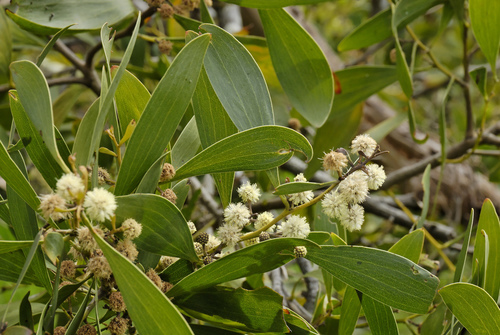
Like most Acacia species, this tree has phyllodes rather than true leaves. The glabrous, glossy, leathery phyllodes are dark green to greyish-green, 4 to 16 cm (1.6 to 6.3 in) long, 6 to 30 mm (0.24 to 1.18 in) wide, and variable in shape. They are most often narrowly elliptic to lanceolate, straight to slightly curved, commonly taper toward the base, and marked with three to five prominent longitudinal veins.
Flowering Details
In its native habitat, A. melanoxylon blooms between July and December. It produces inflorescences that grow in groups of two to eight on an axillary raceme. The spherical flower heads are 5 to 10 mm (0.20 to 0.39 in) in diameter, holding 30 to 50 densely packed pale yellow to nearly white flowers.
Seed Pod Features
After flowering, smooth, firmly papery, glabrous seed pods develop. These pods are curved, twisted, or coiled, with a biconvex shape; they measure 4 to 12 cm (1.6 to 4.7 in) long and 5 to 8 mm (0.20 to 0.31 in) wide, and contain longitudinally arranged seeds.
Distribution
Native Range Overview
In its native range, A. melanoxylon occurs along Australia’s east coast, extending from northern Queensland, through New South Wales and Victoria, and west along the south coast of South Australia. It is also found along the east coast of Tasmania, and has become naturalised in Western Australia.
New South Wales Distribution
In New South Wales, it is widespread from coastal areas into the Great Dividing Range, and does not occur further inland. It is common at higher altitudes in the Nandewar Range, Liverpool Range, and around Orange to the west.
Habitat and Soil
It grows mostly as part of wet sclerophyll forest communities or near cooler rainforest communities. Its range stretches from the Atherton Tableland in northern Queensland along the coast to approximately the Mount Lofty Range in South Australia. It can grow in a wide range of podsols, particularly sandy loams.
Uses
Indigenous Applications
Indigenous Australians use many parts of A. melanoxylon for various purposes: harvested seeds are consumed as a common bush tucker food; leaves can be used as soap or a fishing poison; bark is harvested to make string or prepared as a traditional analgesic; wood is commonly used to make clap sticks, spear-throwers, and shields. When grown among other fire-resistant species in rural areas, the live plant is used as a fire barrier.
Commercial Timber Uses
Its timber (commonly called blackwood) is commercially milled for wood paneling, furniture, joinery, cabinetry, tool handles, boat-building, inlaid boxes, and wooden kegs. It is often compared qualitatively to walnut hardwood, and its physical properties make it well-suited for steam shaping.
Specialty Uses
Bark contains approximately 20% tannin, and the timber is processed to produce decorative wood veneer. Both plain and figured Australian blackwood is used for musical instruments, especially guitars, drums, Hawaiian ukuleles, violin bows, and organ pipes. More recently, blackwood has grown in value as a substitute for koa wood.