About Pulsatilla grandis Wender.
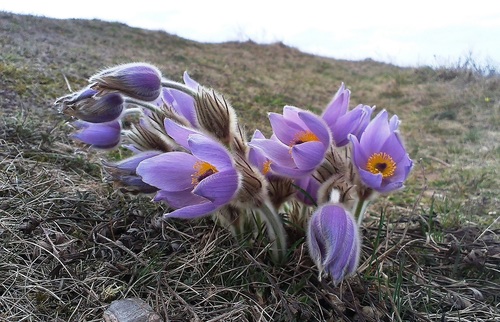
Pulsatilla grandis Wender. is a perennial herbaceous plant that grows to heights between 5 and 30 centimetres. Upright stems grow from a basal cluster of leaves, and each basal leaf connects to the stem via a long stalk. The basal leaves are finely divided, branching two to four times into narrower leaflets with deeply notched (incised) margins. Its erect flowers are funnel-shaped, with broadly elliptical petals that are typically violet and densely covered in fine, silky hairs. Flower color in this species varies across a range of violet shades. After flowering, the plant produces dry, single-seeded fruits called achenes.
Pulsatilla grandis grows in a variety of habitats, primarily in central Europe. Its range extends across Great Britain, western France, Belgium, the Netherlands, Sweden, Austria, Switzerland, Germany, Poland, Hungary, Moldova, Romania, and reaches its eastern limit in Ukraine. In Ukraine, the species has a scattered distribution, with populations found mostly in the Podilia and Pre-Carpathians regions, occurring occasionally in the Right-Bank Forest-Steppe, and only infrequently in the Left-Bank Steppe.
In Ukraine, Pulsatilla grandis grows most commonly in the broadleaved forest zone, where 48 distinct growing sites have been recorded, the highest concentration of any area in the country. Within this zone, it grows mainly on southern and south-eastern slopes of steppe-like hillsides, found in the specific physical-geographical regions of Male Polissya, Roztochia-Opillia hills, West Podollia Upland, and the Prut–Dniester Upland. This species has undergone major habitat loss across these areas, and some sites documented historically are no longer extant, especially those near larger cities or settlements, a change likely caused by human activity.
In the forest-steppe belt, populations of Pulsatilla grandis are fragmented, occurring across several highland areas including the North-western and North-eastern Prydniprovia, the Kyiv highland, and central Transnistria. In this belt, plants are mostly restricted to rocky, steep, granite-exposed southern slopes. Many historically recorded sites no longer support populations of the species, which further highlights its vulnerability. The steppe region holds even fewer localities: the species was historically found in the Oril–Samara and Pryazovia lowlands, but current populations have declined sharply or disappeared entirely due to human impacts including afforestation and land-use changes connected to military training grounds.
In the Pre-Carpathians, Pulsatilla grandis strongly prefers meadow-steppe slopes and forest clearings. It was first recorded in this region from 19th-century herbarium collections. While several historic localities have been lost or not confirmed in recent years, the region still supports a number of populations, mostly in the Bukovinian Pre-Carpathians. Human-caused factors including grazing, land cultivation, and flower collection have caused measurable population declines in this area as well.
In Slovenia, Pulsatilla grandis is called velikonočnica, the Easter flower. It is a rare, protected plant with just four growing sites in the country, all located in the sub-Pannonian phytogeographical area in northeastern Slovenia. The plant is the symbol of the Boč–Donatus Mountain Landscape Park. In the 2000s, a stone sculpture of the flower created by sculptor Franc Tobias from Razvanje was installed for public display on a small rise near the Boč growing site. Pulsatilla grandis is also depicted on the coat of arms of the Diocese of Celje.