About Ptilidium californicum (Austin) Underw. & O.F.Cook
Nomenclature and Breeding System
Ptilidium californicum (Austin) Underw. & O.F.Cook is a dioicous liverwort species.
Size and Coloration
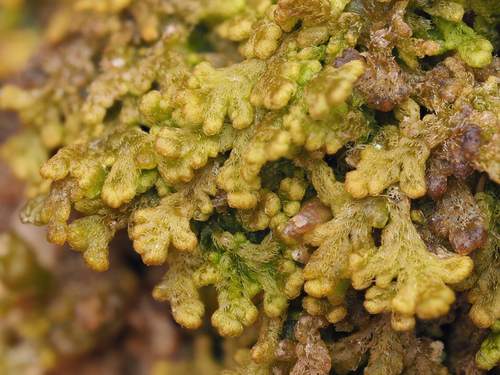
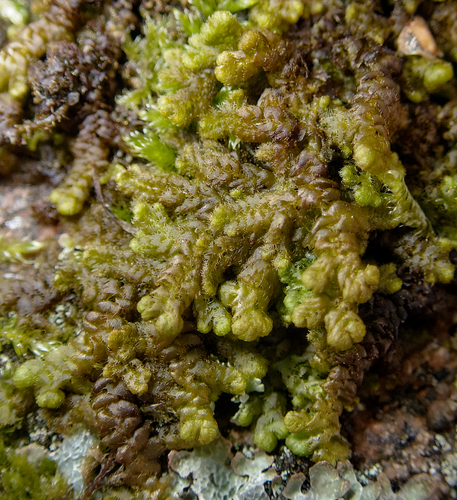
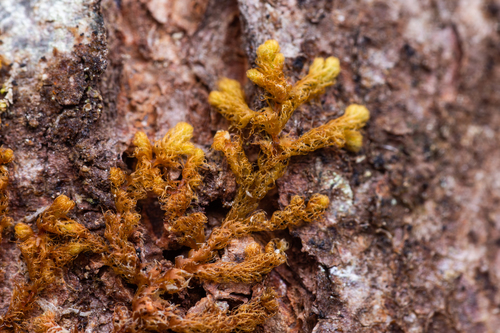
Individuals are small but medium-sized for a liverwort, with color ranging from golden-green to golden, though they are more typically reddish-brown, dilute purplish-red, or coppery red.
Growth Form
These plants form dense fuzzy mats that grow in either small or large patches.
Shoot Width
Shoots measure less than 1½ mm wide.
Leaf Arrangement and Structure
Its leaves are incubous, meaning they are decurrent on the dorsal stem surface, and are deeply bilobed; each lobe divides 1 to 3 times, is elongated and narrowly lanceolate, and is deeply divided.
Lobe Margin Features
Lobe margins are entire, with 1 or 2 long, slender cilia-like projections along the margins and at lobe apices.
Leaf Overlap
Leaves are so closely overlapping that only a mass of ciliate projections is visible when viewed through a hand lens.
Underleaf Characteristics
Underleaves are prominent, wider than the stem, about half the size of the main leaves or smaller, 2 to 3 clefted, and have ciliate margins that are even more finely divided into slender projections.
Perianth Features
Frequent perianths are plicate and narrowed toward a ciliate mouth.
Sporophyte Development Period
Abundant sporophytes develop from May to August.
Field Identification
For field identification, the many leaf lobes divided into slender cilia make this species unmistakable.
Geographical Range
While it was previously reported to grow in Russia and Japan, recent literature classifies this species as endemic to the west coast of North America, where its range stretches from southeastern Alaska to northern California.
Habitat Indicator Role
This species has narrow environmental requirements; it grows in old-growth forest and acts as an indicator species for this habitat.
Primary Substrate
It is typically epiphytic, growing on bark at the base of standing mature to old-growth trees including Abies concolor, A. magnifica, and Pseudotsuga menziesii, or on recently fallen logs.
Secondary Substrates
It grows rarely on other organic substrates, such as decaying logs and stumps, or humus that covers boulders.
Southern Range Habitat Restriction
At the southern end of its range in Oregon and California, this species is distinctly restricted to middle elevation forests.
Elevational Range
Its overall elevational range is 389–1,745 m, or 1,275–5,725 feet.
Potential Fire Impacts
The fire ecology of this plant is not currently studied, but fires in old-growth habitat may negatively impact P. californicum via smoke damage or excessive canopy opening.
Severe Fire Outcome
Severe fires that destroy old-growth trees would likely extirpate local populations of this species.