About Pterostylis pedunculata R.Br.
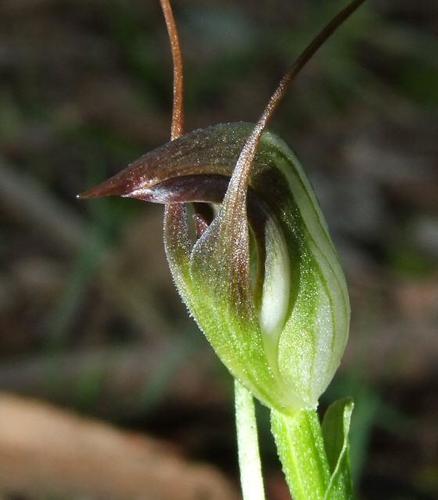
Pterostylis pedunculata R.Br. is a terrestrial, perennial, deciduous herb that grows from an underground tuber. When flowering, it produces a rosette of two to six stalked leaves; each leaf measures 10 to 65 millimetres long and 5 to 20 millimetres wide. A single flower, 15 to 20 millimetres long and 5 to 7 millimetres wide, is borne on a flowering spike that stands 60 to 250 millimetres high. The flowers are green, white near their base, and have reddish-brown to black tinges near the tip. The dorsal sepal and petals are fused together to form a hood, also called a "galea", that covers the column. The dorsal sepal is slightly longer than the petals, and ends in a sharp point. A gap exists between the petals and the lateral sepals, which have thread-like tips 16 to 30 millimetres long. The sinus between the two lateral sepals has a deep, V-shaped notch at its centre. The labellum is 5 to 7 millimetres long, about 3 millimetres wide, reddish-brown, egg-shaped, straight, and just visible above the sinus. Flowering takes place from July to November. Common called the maroonhood, this orchid is widespread and common in moist, sheltered forest locations, and also grows in coastal scrub. It occurs from south-eastern Queensland to south-eastern South Australia, and is also found in Tasmania. In New South Wales, it grows mostly in coastal and near-coastal districts, and extends inland as far as the Australian Capital Territory.