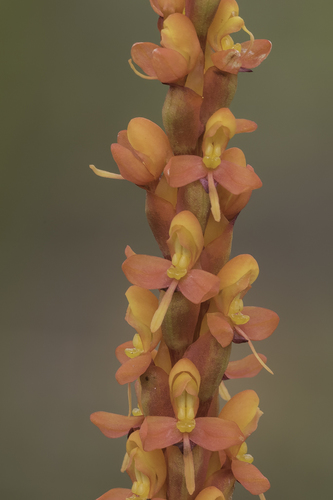
About Pterostylis decurva R.S.Rogers
Taxonomic Identity and Growth Form
Pterostylis decurva R.S.Rogers is a terrestrial, perennial, deciduous herb that grows from an underground tuber.
Non-flowering Vegetative Structure
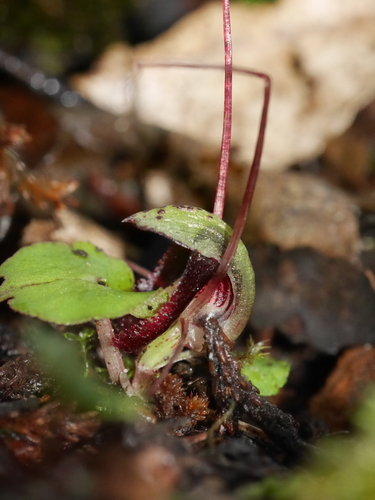
When it is not flowering, it produces a rosette of two to five leaves, which is usually held above the ground on a stalk up to 100 mm long. Each leaf is oblong to egg-shaped, measuring 10–30 mm long and 10–20 mm wide.
Flowering Spike and Flower Size
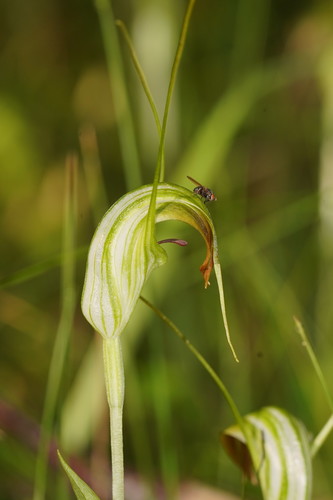
Flowering plants bear a single flower that is 18–25 mm long and 7–9 mm wide, on a spike that reaches 150–300 mm in height, with four or five stem leaves attached to the spike.
Flower Coloration
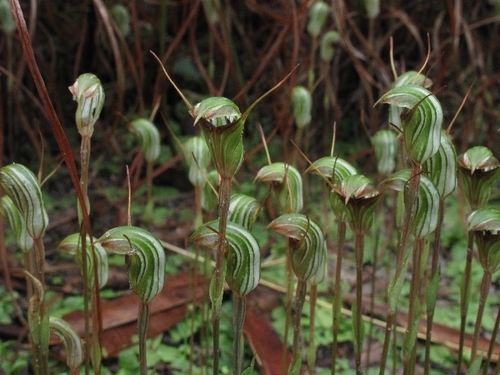
The flowers are white with green stripes, and have a brown tinge in the galea.
Galea Structure
The dorsal sepal and petals are fused together to form a hood, called a "galea", that covers the column. The dorsal sepal curves forward, often downward, and ends in a thread-like tip 15–20 mm long.
Lateral Sepal Characteristics
The lateral sepals are held close against the galea, each has an erect, thread-like tip 30–40 mm long, and there is a broad, slightly protruding, U-shaped sinus between the bases of the two lateral sepals.
Labellum Features
The labellum is 12–15 mm long, 2.5 mm wide, brown, blunt, and curved, and it protrudes above the sinus.
Flowering Period
Flowering of this species takes place from October to March.
Common Name and Distribution
This species, commonly called the summer greenhood, grows on the higher parts of ranges and tablelands in Victoria, New South Wales south from Werrikimbe National Park, and Tasmania; it sometimes also grows at lower altitudes in Tasmania.