About Pterostylis boormanii Rupp
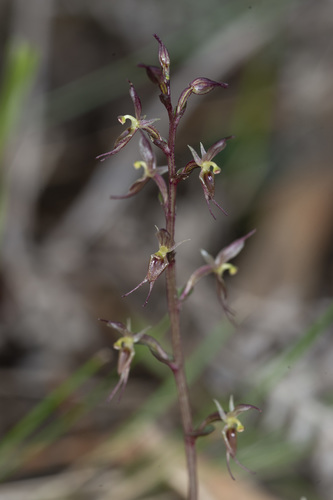
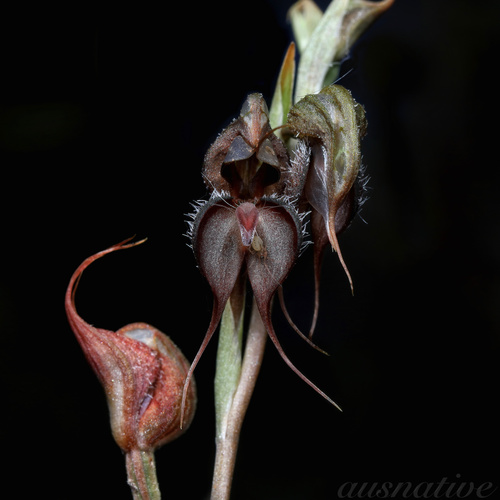
Pterostylis boormanii is a terrestrial, perennial, deciduous herb that grows from an underground tuber. It produces a rosette of 8 to 14 elliptic leaves at the base of its flowering spike. Each leaf measures 15–35 mm (0.6–1 in) long and 8–14 mm (0.3–0.6 in) wide, and the leaves usually wither by the time flowering begins. Up to seven dark reddish-brown flowers with translucent windows grow on a flowering spike that stands 50–200 mm (2–8 in) tall. Each flower is 27–30 mm (1.1–1.2 in) long and 10–12 mm (0.4–0.5 in) wide. Between 2 and 5 stem leaves wrap tightly around the flowering spike. The dorsal sepal and petals together form a hood called a "galea" that covers the column; the dorsal sepal has an upturned, thread-like tip 8–10 mm (0.3–0.4 in) long. The lateral sepals point downwards, are wider than the galea, have thickened hairy edges, and taper suddenly to narrow, spreading tips 10–15 mm (0.4–0.6 in) long. The labellum is thick, brown, and insect-like, 4–5 mm (0.16–0.20 in) long and about 2 mm (0.08 in) wide. The "head" end of the labellum has many short hairs, and the "body" has between 5 and 8 hairs up to 4 mm (0.2 in) long on each side. Flowering takes place from September to November. This species, commonly known as Sikh's whiskers, grows in drier forest and scrub, most often in rocky locations, in association with Callitris species. It is distributed in New South Wales south of Narrabri, across inland Victoria, and in the south-east of South Australia, growing in areas with an average annual rainfall of 250–500 mm (10–20 in).