About Pterostylis biseta Blackmore & Clemesha
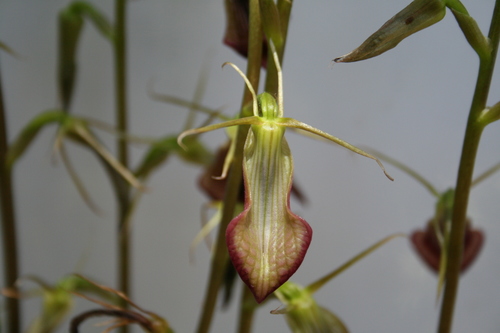
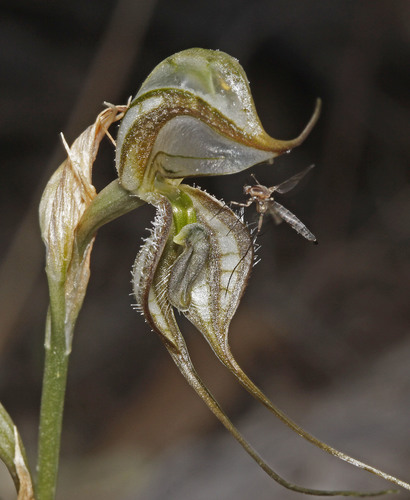
Pterostylis biseta is a terrestrial, perennial, deciduous herb that grows from an underground tuber. It produces a rosette of six to fourteen leaves at the base of its flowering spike. Each leaf is 15–40 mm (0.6–2 in) long and 8–12 mm (0.3–0.5 in) wide, and leaves are often withered by the time flowering begins. Up to seven translucent green and brown flowers grow on a flowering spike that is 100–350 mm (4–10 in) tall. Each flower is 50–58 mm (2.0–2.3 in) long and 12–14 mm (0.5–0.6 in) wide. Two to six papery bracts wrap around the flowering spike. The dorsal sepal and petals are joined to form a hood called the "galea" that covers the column, and the dorsal sepal has a thread-like tip 11–15 mm (0.4–0.6 in) long. The lateral sepals are wider than the galea, dished, and densely hairy on their outer edges. They narrow suddenly to a thread-like tip, and are roughly parallel to one another, with tips measuring 25–35 mm (0.98–1.4 in) long. The labellum ranges in color from brown to green, is thin and insect-like, and measures 6–8 mm (0.2–0.3 in) long and about 4 mm (0.2 in) wide. Its "head" end is swollen and bears two long bristles, and up to 34 shorter bristles grow along the sides. Flowering occurs between September and November. As currently described by the National Herbarium of New South Wales, Pterostylis biseta occurs in New South Wales south of Hillston, in northern Victoria, and in the south-east of South Australia. It grows in sparse forest (often on rocky ridges) and in arid scrubland.