About Pterodroma phaeopygia (Salvin, 1876)
Species Comparison
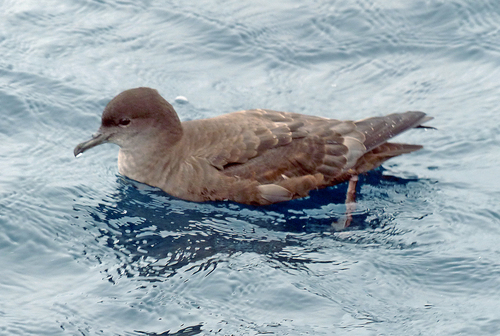
Pterodroma phaeopygia, the Galápagos petrel, is very similar to the Hawaiian petrel.
Upper Body Appearance
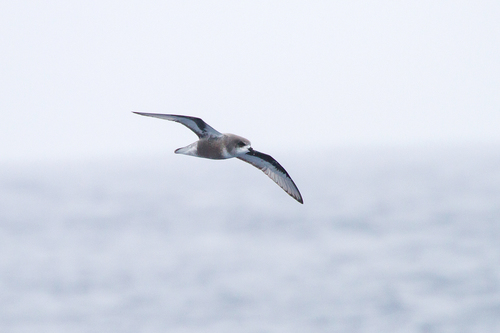
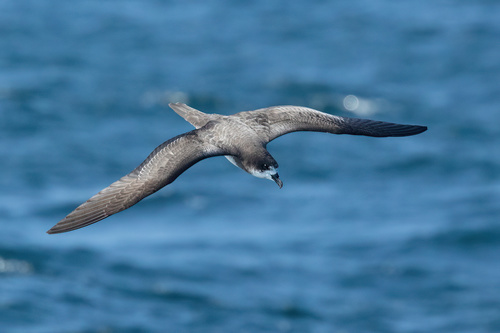
Both are large, long-winged gadfly petrels with an overall dark-gray upper surface that darkens gradually toward the tips of the wings and tail. A narrow white line on each side of the rump is often present.
Head and Underpart Coloration
The group has a distinct black hood that extends to the sides of the neck, while the face and underparts are white.
Underwing Markings
Underwings have black margins and a diagonal bar that runs from the coverts to near the base of the wings.
Forehead Pattern Differences
All Hawaiian petrels have entirely white foreheads, but many Galápagos petrels have black freckles on this area.
Leg and Foot Coloration
Galápagos petrels have pink legs and feet, with black webbing.
Plumage Consistency
They do not show sexual dimorphism, and juveniles cannot be told apart from adults. Adult feathers sometimes develop a brown tinge from abrasion, but their plumage stays relatively consistent throughout the year.
Molt Pattern
Details of their molt are not well understood, but it appears most feather replacement happens during the non-breeding season.
Bill Structure and Function
Like all gadfly petrels, Galápagos petrels have short, stout, hooked bills with sharp edges, which they use to seize, manipulate, and cut up small prey.
Nasal and Sensory Traits
A key trait of this group is external tubular nostrils, which supports an ability to smell, detect, and locate food. They can even find their own nest burrow within a breeding colony in the dark.
Interspecific Morphological Differences
Despite these many similarities, there are subtle differences between Galápagos and Hawaiian petrels. Galápagos petrels have longer, narrower bills than Hawaiian petrels.
Weight Comparison
They are also lighter on average: the average Galápagos petrel weighs 420 g (15 oz), while the average Hawaiian petrel weighs 434 g (15.3 oz).
Wing and Tarsus Morphology
Galápagos petrels have longer wings and longer tarsi than Hawaiian petrels, but their total wing area and weight-to-wing area ratio are slightly lower.
Flight Performance
This gives Galápagos petrels lower flight speed but greater agility.
Endemic Range
The Galápagos petrel is endemic to the Galápagos Islands.
Dispersal Patterns
It is mainly found within the Galápagos Marine Reserve, but studies show individuals regularly leave the reserve to disperse northeast toward South America, and up to 2,000 km (1,200 mi) southward between January and February.
Pelagic Habitat
Like other gadfly petrels, these subtropical seabirds are highly pelagic and poorly adapted to terrestrial habitats, so they are usually found far from land and only return to land to breed at nesting colonies.
Nesting Colony Locations
Nesting colonies are located on five Galápagos islands: Santiago, Floreana, Isabela, Santa Cruz, and San Cristobal, all of which are less than 170 km (110 mi) apart.
Colony Size and Spacing
One island can hold multiple colonies; individual colonies can measure up to 200 m by 300 m, and are separated from each other by distances ranging from 300 m to 5 km.
Nesting Habitat Shifts
Today, Galápagos petrels most commonly nest on offshore islets, because their original nesting habitats have been destroyed or displaced by human-caused disturbance.
Nest Site Elevation and Substrate
Nests are typically found in highlands at least 180 meters (110 mi, likely a reference to elevation correction, retained as source) above sea level, most often in thickly vegetated areas with soft soil suitable for digging deep burrows. Some individuals also nest in volcanic crevices.
Predation Vulnerability
Because they nest on the ground, the species is more vulnerable to introduced predators.
Sexual Maturity and Breeding Frequency
Pterodroma species reach sexual maturity at 5 to 6 years of age, and generally nest once per year after reaching maturity.
Island-Specific Breeding Seasons
Breeding seasons differ between Galápagos petrel populations on different islands: on Santa Cruz and Santiago, the breeding season runs from March to January; on Isabela, from late April to January; on Floreana, from October to August; and on San Cristobal, from May to October.
Interpopulation Breeding Isolation
While some breeding seasons overlap, there is little to no interbreeding between these populations. This lack of interbreeding has likely led to population divergence, driven by the species' rigid breeding cycles and high fidelity to both mates and nesting sites.
Nest Preparation
Mature individuals either dig new burrows or use abandoned rabbit burrows, preparing for nesting by enlarging the burrow and gathering dry vegetation to line it.
Courtship Displays
When seeking a long-term mate, male gadfly petrels perform specific displays to attract females. They do elaborate courtship flights that include aerial chasing, high-speed swoops, and climbing upward, all accompanied by loud calls.
Pair Bonding Behaviors
Breeding pairs stay together in their burrow, and engage in mutual preening and a series of calls.
Pre-Laying Feeding Period
After copulation, both adults return to the sea to feed heavily in preparation for gestation and the long incubation period that follows.
Pre-Laying Nest Visitation
During the pre-laying period, which lasts around two weeks, each pair member makes short visits to the nest to prevent it from being perceived as abandoned.
Egg Characteristics
Each breeding pair lays a single ovate white egg. In studies of Galápagos petrels, eggs weigh around 17 or 20% of the female's body weight, while the average for all gadfly petrels is 20 to 24% of female body weight.
Incubation Behavior
Incubation lasts about 50 days, with the male and female taking turns incubating the egg for an average of 12 days per shift. While incubating, parents lose an average of 10–15 g (0.35–0.53 oz) per day, and the non-incubating parent forages at sea with no recorded returns to feed their partner.
Egg Survival Adaptations and Threats
Eggs are rarely left unattended, but both parents may leave the nest to forage when food is scarce. As an adaptation to this behavior, the eggs are resistant to cold. However, introduced black rats (Rattus rattus) prey on the eggs.
Chick Down Feathers
After hatching, chicks are covered in off-white down on the front and sides of the throat, and on the center of the belly.
Chick Development and Feeding
Parents take turns feeding the chick, and chicks gain weight quickly, eventually exceeding the weight of their adult parents. Galápagos petrel chicks are adapted to food scarcity, as they can tolerate starvation.
Chick Feather Growth
A second layer of down grows in after around 10 days, and adult feathers emerge after 5 weeks. Once chicks are fully feathered and resemble molted adults, parents stop visiting the nest to feed them.
Nesting Success Rate
Overall, the nesting success of Galápagos petrels is low.