About Pterocles alchata (Linnaeus, 1766)
Species Identification and Size
The pin-tailed sandgrouse, Pterocles alchata, is a robust, medium-sized bird with a total length ranging from 31 to 39 centimetres (12 to 15 inches).
General Plumage Coloration
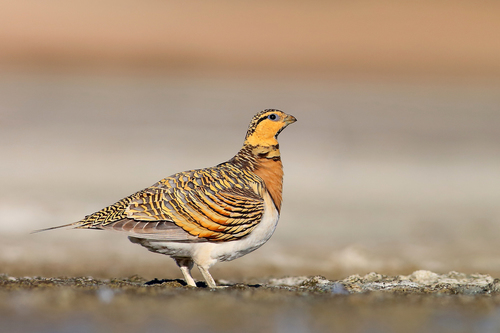
Its overall plumage is cryptically colored, formed by a mixture of barred and flecked olive green, brown, buff, yellow, grey, and black. Its underparts and feathered legs are dull white.
Sexual Dimorphism Note
The species is sexually dimorphic, and male plumage changes with the time of year.
Breeding Male Upper Body Plumage
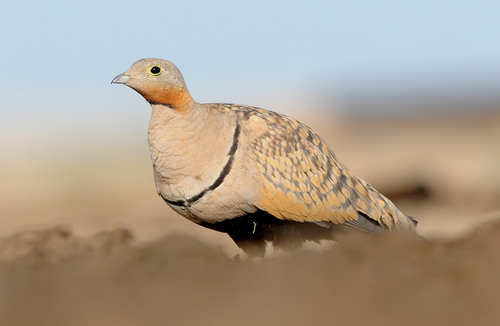
During the breeding season, the male has yellowish-green coloration on the crown, most of the neck, back, and under-wing coverts, with dull yellow spots on the shoulder area. The male's cheeks are also yellow, with a narrow black line running from the beak through the eye to the nape.
Breeding Male Head and Throat Features
It has brown irises and a slatey grey beak. There is a black patch on the throat just below the beak, below which sits a broad reddish-brown breast band bordered by thin black stripes on both the top and bottom.
Breeding Male Wing Features
Outer wing coverts are chestnut with black and white edges, and primaries are black with pale edges, which gives the wing both a leading and trailing black rim when the bird is in flight.
Breeding Male Rump and Tail Features
The rump and tail are distinctly barred with black and brownish-yellow, and the streamers on the central tail feathers are slate-grey.
Non-Breeding Male Plumage
Outside of the breeding season, all upper parts, including the crown and cheeks, are barred with black and brownish-yellow, and the throat loses its black patch and becomes whitish.
Female General Plumage
The female is generally similar to the male but has duller overall coloration. Her cheeks and neck are golden-buff and do not have the greenish tint seen on the male.
Female Head and Breast Features
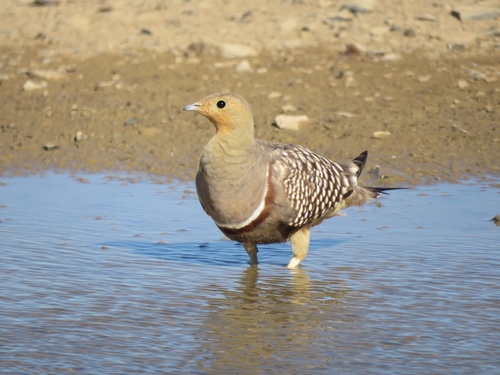
A black stripe runs through her eye. Her chin is white, and she has an extra yellow-buff band across the breast, with a broad black stripe above this band, another thinner black stripe about a third of the way down the breast, and a final narrow black stripe at the base of the breast.
Female Back, Wing, and Tail Features
Her back and wings are grey and barred with black. Her rump and tail (which has shorter central feathers than the male) are similar in coloration to the male's but have finer black barrings.
In-Flight Identification
In flight, pin-tailed sandgrouse can be identified by their bright white underparts and under-wing coverts, as well as the long feathers in the center of the tail.
Vocalizations
They are usually silent when on the ground, but communicate with other birds in the air, frequently calling a loud "kattar-kattar", a nasal "ga-ga-ga", and a low-pitched "gang gang".
Breeding Range
Pin-tailed sandgrouse breed in North Africa, the Middle East, Turkey, Iran, Iraq, and Kazakhstan. In Europe, their breeding range includes Spain, Portugal, and southern France.
Migratory Patterns
Eastern populations, particularly those from Kazakhstan, migrate to Pakistan and parts of northern India for winter.
General Habitat
They inhabit open stony land, semi-arid areas at the edge of deserts, and treeless plains, and occasionally occur on dried-out mud flats.
Winter Habitat and Substrate Preference
In winter they may visit ploughed or fallow land, but they prefer sandy soils.
Habitat Comparison with Related Species
They rely on much less vegetation cover than the black-bellied sandgrouse (Pterocles orientalis), which shares a similar range.
Elevation Range
They do not occur at elevations above about 1,000 metres (3,300 feet).