About Psilopogon rafflesii (R.Lesson, 1839)
Common Name & Taxonomy
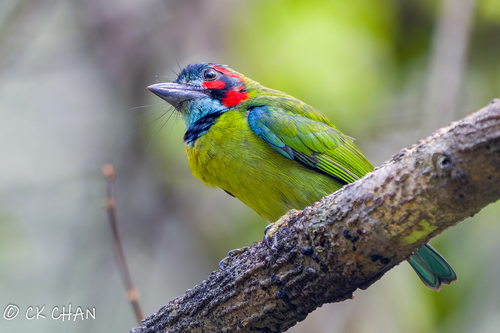
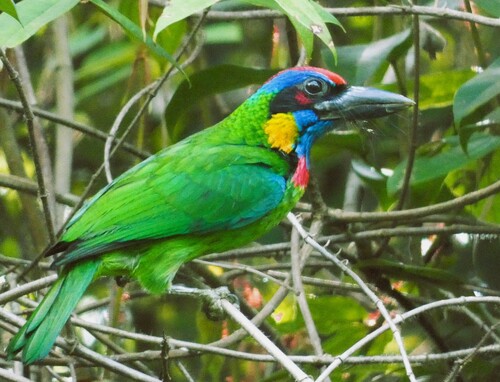
Psilopogon rafflesii, commonly known as the red-crowned barbet, is a medium-large tropical bird.
Size
Adults measure 24.5–27 cm (9.6–10.6 in) in length and weigh 99–150 g (3.5–5.3 oz).
Adult Plumage
Both sexes are primarily green, with a red crown, red spots below the eyes, and a red marking on the side of the neck. This species has a blue throat, broad supercilia, and a black and yellow face.
Immature & Female Plumage
Immature birds and females resemble males, but have duller overall plumage, a form of monomorphism.
Geographic Range
The red-crowned barbet is found in Sundaic upland and lowland habitats across south Tenasserim (Myanmar), peninsular Thailand, Sabah, Sarawak, Peninsular Malaysia, Singapore, Kalimantan, Sumatra (Indonesia), and Brunei.
General Habitat
It occupies the lower forest canopies of both primary and secondary growth forests, and has been observed foraging in rubber and durian (Durio zibethinus) plantations. It also inhabits sloped forests and lowland evergreen forests.
Singapore Distribution
In Singapore, deforestation has restricted the species to only the Bukit Timah Nature Reserve.
Breeding Season Length
The red-crowned barbet's breeding season runs from April to May, totaling 36 days.
Pre-Courtship Calls
Before courtship, both sexes produce loud, constant calls during morning and evening hours: females call "kotroo kotroo" while males call "kurro kuroo".
Courtship Initiation
Once a female locates a male, courtship begins: the male perches beside the female and preens her feathers.
Courtship Feeding
If the female accepts him, the male flies off to collect insects and fruits, then returns to pass the food to her to eat.
Mating Initiation
After 10 to 20 minutes of this behavior, the female initiates mating through soft churning calls, swinging her tail horizontally, fluffing her feathers, and pulling her wings down slightly.
Nest Site Selection
The breeding pair selects a dead tree to excavate a nest hole approximately 20 to 30 feet above the ground. Researchers hypothesize the nest hole is typically oriented facing south to protect the contents from monsoon rains.
Nest Excavation Process
As the pair excavates, they remove bits of wood and dust from the hole using their beaks and drop them to the ground.
Completed Nest Structure
The completed nest is about 30 cm deep, with a smooth chamber at the bottom to hold the eggs. Access to the chamber runs through a tunnel 4.5 cm in diameter; after a slight drop, the tunnel widens into the chamber, which reaches around 16 cm (6.3 in) across.
Nest Material
The smooth walls of the nesting chamber mean no additional nesting material is required.
Egg Characteristics
The female lays an average of three glossy white, elongated eggs with an oval end, averaging 26.20 mm by 20.30 mm in size.
Incubation Behavior
Both parents take turns incubating the eggs, exchanging roles every 20 to 30 minutes, over an incubation period of 14 to 15 days.
Post-Hatching Chick Care
After the eggs hatch, both parents collect food for the chicks, pass food directly to the young, and remove fecal sacs from the nest to keep it clean.
Adolescent Chick Feeding
Once chicks reach adolescence, identifiable by dull coloration on the forehead, adult males and females feed the young from the entrance of the nest.