About Psilopogon haemacephalus (P.L.S.Müller, 1776)
Scientific Naming and Core Plumage
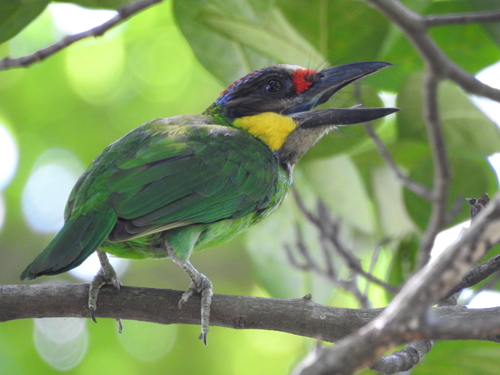
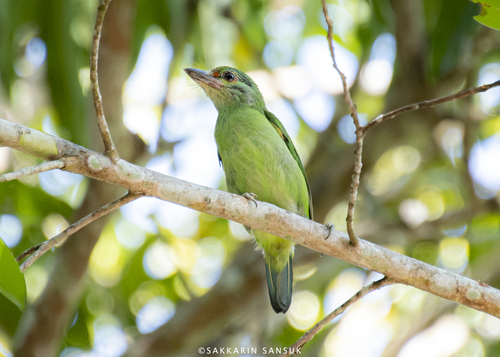
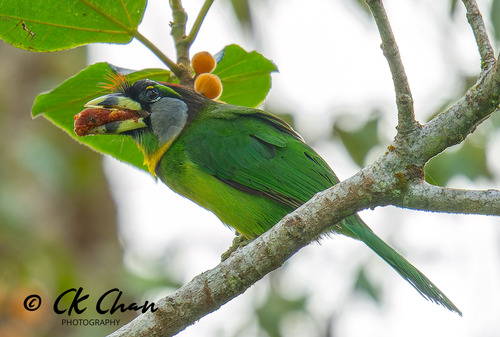
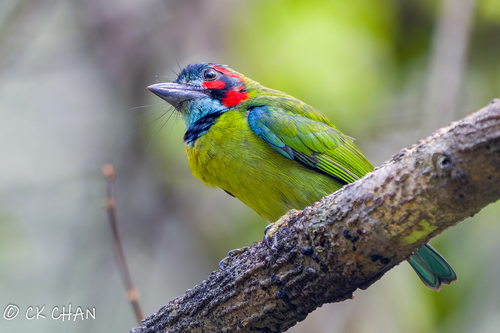
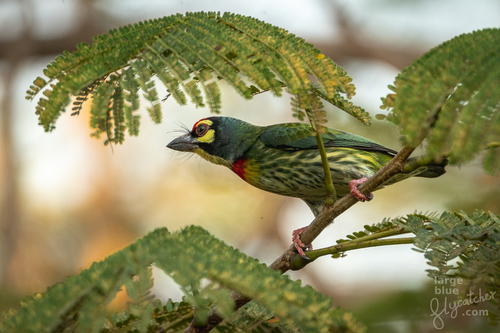
The coppersmith barbet, with the scientific name Psilopogon haemacephalus (P.L.S.Müller, 1776), has distinctive plumage: it is primarily green, with a red head, yellow cheeks and a yellow throat. Its underparts have grey and black streaks.
Seasonal Plumage Variation
During the nesting season, feather wear can make the upper back plumage appear bluish.
Size and Weight
Adults measure 15–17 cm (5.9–6.7 in) in length and weigh 30–52.6 g (1.06–1.86 oz).
General Habitat Preferences
Across its distribution, the coppersmith barbet lives in gardens, groves, and sparse woodland. Habitats that include dead wood suitable for excavating nests are particularly important for this species.
Elevation Range
It occurs below 1,200 m (4,000 ft) in the Palni Hills, and in northern India, it is found in the valleys of the outer Himalayas up to 910 m (3,000 ft).
Regional Abundance
It is rare in northwestern Indian states and in the wet forests of Assam.
Range Overlap
The coppersmith barbet's range overlaps with the ranges of several larger barbet species across most of South Asia, and it has partial range overlap with the Malabar barbet in the Western Ghats.
Social Grouping
Coppersmith barbets live alone or in small groups; larger groups have occasionally been observed on abundantly fruiting Ficus trees.
Sunbathing Behavior
The species often sunbathes in the morning on bare top branches of tall trees, and individuals will frequently move around to sit next to one another.
Flight Characteristics
It flies in a straight path with rapid wing flaps.
Interspecies Competition
The coppersmith barbet competes with other cavity-nesting birds and frugivores.
Interspecies Antagonism
Blue-throated barbets have been observed evicting coppersmith barbets from their pre-excavated nest holes, while red-vented bulbuls engage in kleptoparasitism, robbing males of berries they have collected to bring to females at the nest.
Roost Site Usage
Coppersmith barbet nest holes are also used for roosting. Some individuals roost alone in cavities, often roosting there for part of the day.
Family Roosting Behavior
Immature coppersmith barbets roost together with their parents; they typically return to the roost cavity early to avoid being blocked from entering by the adult parents.