About Pseuderanthemum variabile (R.Br.) Radlk.
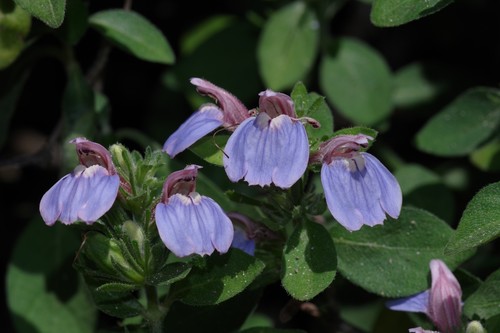
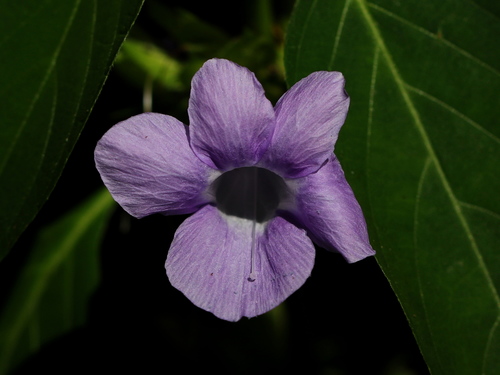
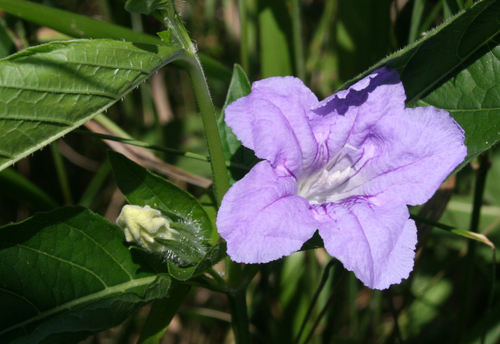
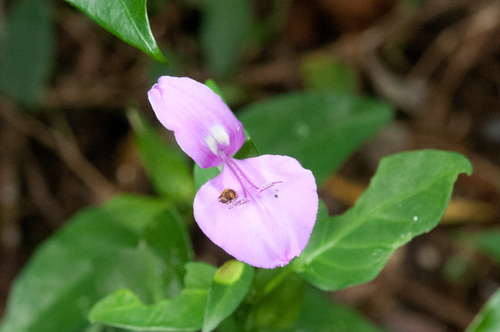
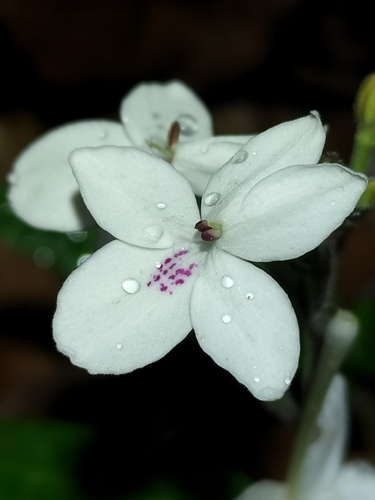
Pseuderanthemum variabile (R.Br.) Radlk. is a creeping herb with a highly variable appearance, growing up to 30 cm (12 in) tall. All parts of the plant may be covered in fine short hairs (pubescent). Its wiry stems are around 1–2 millimetres (0.04–0.08 in) wide. Leaves are arranged oppositely in a decussate pattern; they are lanceolate to ovate in shape with smooth entire margins. Leaves measure up to 7 cm (2.8 in) long by 4 cm (1.6 in) wide, with petioles up to 30 mm (1.2 in) long, and have 3 to 6 lateral veins on each side of the midrib. Leaf colour varies greatly: the upper surface is usually dark green to mid-green, but may have varying amounts of light grey or, rarely, purple patterning. The lower leaf surface is usually light green, but may also be purple or dark red. The inflorescence grows from the terminal axil. The flowers are zygomorphic with five petals. Two of the petals are smaller than the others and are usually positioned at the top of the flower; these measure around 7 by 4 mm (0.28 by 0.16 in) and overlap each other slightly. Two more petals are held perpendicular to the first pair, one on each side of the flower. The fifth and largest petal sits opposite the first pair, measuring about 10 by 6 mm (0.39 by 0.24 in), and is often marked with a variable number of small purple spots. Petals can be any shade from white to pink or lilac. The fruit is a capsule up to 15 mm (0.59 in) long, and may be either pubescent or smooth (glabrous). This species is native to Papua New Guinea, eastern New South Wales and Queensland in Australia, and New Caledonia. It has been introduced to Florida, South Carolina and Puerto Rico. In Australia, it grows in a range of forest types, most commonly rainforest and wet sclerophyll forest, but also occurs in woodlands, open forest and deciduous vine thickets. Pseuderanthemum variabile is a food plant for caterpillars of multiple butterfly species in the family Nymphalidae, including Doleschallia bisaltide, Hypolimnas alimena, Hypolimnas bolina, Hypolimnas misippus and Junonia orithya. It is considered an attractive garden plant, used as a feature plant, ground cover, or gap filler in rockeries. It grows easily from seed or cuttings. In Australia, some orchid nurseries report it as a pest, because it often colonizes growing pots and can be difficult to remove completely.