About Pseudacris crucifer (Wied-Neuwied, 1838)
Common Name & Etymology
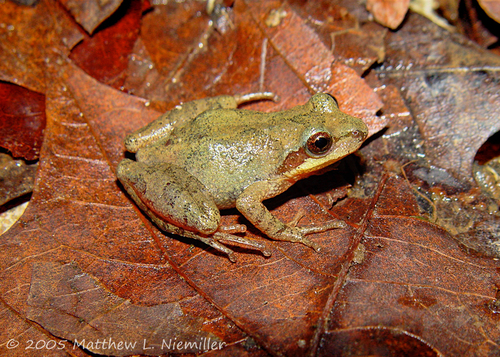
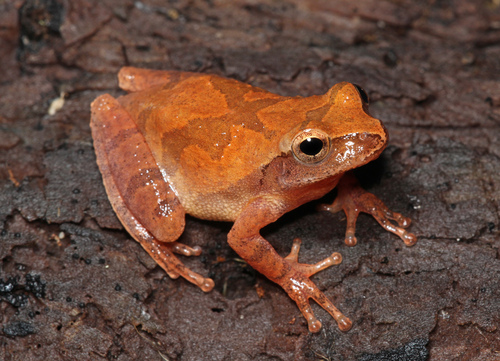
Pseudacris crucifer, commonly known as the spring peeper, is a small frog that typically has a tan, grey, or brown body with a dark cross-shaped marking on its back — this marking gives the species its Latin specific epithet crucifer, which means cross-bearer, though the marking can sometimes be indistinct.
Additional Markings
Additional dark markings include lines between the eyes and a crossband on the hindlimbs.
Adult Size
Adult body length ranges from under 25 mm (0.98 in) to 38 mm (1.5 in), and adult body mass ranges from 3 g (0.11 oz) to 5 g (0.18 oz).
Lip Coloration
Unlike some other species in the Pseudacris genus, P. crucifer does not have white lines on its lips, though its lips may be a lighter shade than the rest of its head.
Intraspecific Groups
There are two main groups of spring peepers with distinct geographic ranges.
Southern Spring Peeper Range
The southern spring peeper occupies habitat along the U.S. Gulf Coast, from southeastern Texas to southeastern Georgia and northern Florida.
Northern Spring Peeper Range
The northern conspecific (member of the same species) is found across all territory east of the Mississippi River in the U.S., extends into Atlantic Canadian provinces, and reaches as far west as Saskatchewan, Canada.
General Habitat
Spring peepers live primarily in forests and regenerating woodlands near ephemeral or semipermanent wetlands.
Breeding Wetland Types
They often form breeding aggregations that can number several hundred individuals, and commonly breed in a wide range of wetland types: temporary vernal ponds that dry out over summer, intermediate ponds that alternate between dry and wet periods each year, year-round permanent ponds, swamps, and disturbed human-created habitats such as farm ponds and borrow pits.
Breeding Season Habitat Requirements
During the breeding season, spring peepers are found near bodies of water that do not contain fish and are free of pollutants.
Breeding Chorus Locations
Breeding choruses form near trees overhanging bushy growth or in secondary forests, and may also be located within ponds, marshes, or swamps.
Calling Activity Triggers
Spring peepers usually resume calling activity during warm rain, and are not commonly seen outside of breeding choruses.
Non-Breeding Habitat
In the non-breeding season, they live among dead plant material from trees, shrubs, and other plants in woodland areas.
Breeding Pond Competitive Ability
While spring peepers can use multiple pond types for breeding, they are superior competitors in permanent ponds due to their greater ability to resist predation in these environments.
Aquatic Development Requirements
As an amphibious species, they require marshes, ponds, or swamps to provide the aquatic environment that their eggs and tadpoles need to develop.
Cold Exposure Risk
In the northern parts of their range, spring peepers regularly experience subfreezing temperatures during the breeding season.
Freeze Tolerance & Hibernation
The species can tolerate freezing of some of its body fluids, and hibernates under logs or behind loose tree bark.
Minimum Freeze Survival Temperature
It can survive freezing of internal body fluids at temperatures as low as −8 °C (18 °F).
Mating Display Environmental Drivers
Male spring peeper mating displays are affected by two key environmental factors: humidity and vegetation density.
Arboreal Mating Behavior Influences
These factors heavily influence the arboreal (tree-dwelling) behavior that spring peepers exhibit during mating.
Temperature & Humidity Effects on Arboreal Behavior
Locations with higher humidity and higher air temperature see more dominant arboreal behavior, suggesting latitude may impact this trait.
Latitudinal Arboreal Behavior Pattern
Spring peepers in warmer areas generally exhibit more arboreal behavior than those in cooler environments.
Calling Position Quality
Mating calls from males calling above ground are of better quality than calls from males calling near the ground.
Vegetation Effects on Call Quality
Local vegetation also improves calling from arboreal positions compared to lower positions, because lower-level spatial features can interrupt the call.
Migration Timing
Spring peepers almost always migrate at night, most likely to prevent their bodies from drying out.