About Psammophis mossambicus Peters, 1882
Scientific Name and Common Name
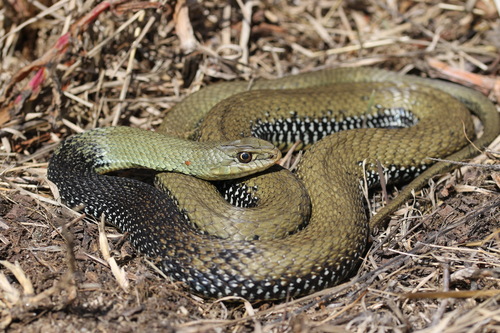
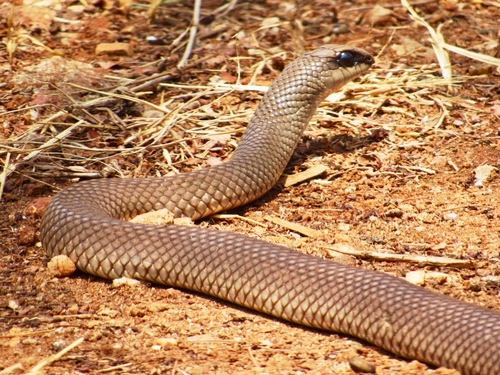
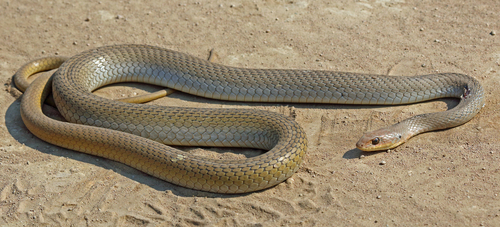
Psammophis mossambicus Peters, 1882, commonly called the olive grass snake, reaches 100 to 180 cm (roughly 3–5 feet) in total length.
Coloration
This species is olive-brown in color, with dark-edged scales and a lighter-colored underside.
Habitat
It inhabits relatively moist areas located near a water source.
Defensive Posture Similarity
It is often confused with the black mamba because it can raise its head in a similar way to mambas, cobras, and other elapid snakes.
Dentition Type
Unlike these elapids, the olive grass snake is opisthoglyphous, meaning it is rear-fanged, with small teeth positioned at the back of the mouth.
Venom Function and Prey
These teeth deliver mild venom and/or toxic salivary compounds, which the snake uses primarily to subdue small, slippery or squirmy prey such as frogs, lizards, and some rodents.
Venom Toxicity to Humans
The species is considered only mildly venomous to humans.
Envenomation Effects
No human deaths from its bite have been recorded, but possible side effects of envenomation include local pain and swelling, nausea, and fatigue.
Afrikaans Common Name
In Afrikaans, this snake is called olyfkleurige grasslang.
Southern Africa Distribution
Psammophis mossambicus is native to Southern Africa, where it occurs in Angola, Botswana, Eswatini, Malawi, Mozambique, Namibia, eastern South Africa, Zambia, and Zimbabwe.
Northern and Central Africa Distribution
It can also be found as far north as southern Chad, with additional recorded populations in the Central African Republic, Democratic Republic of the Congo, Gabon, Kenya, South Sudan, Tanzania, and Uganda.