About Protea effusa E.Mey. ex Meisn.
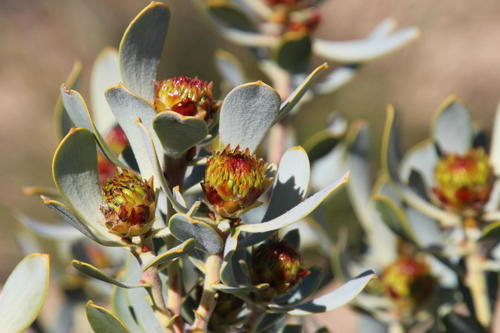
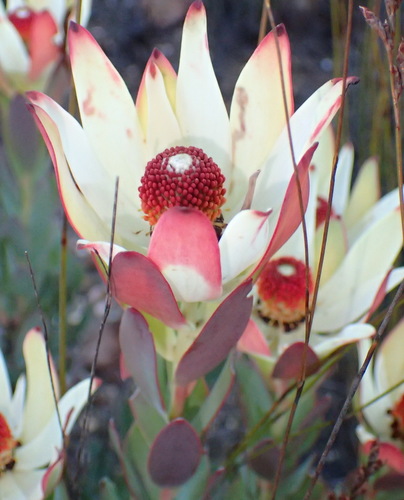
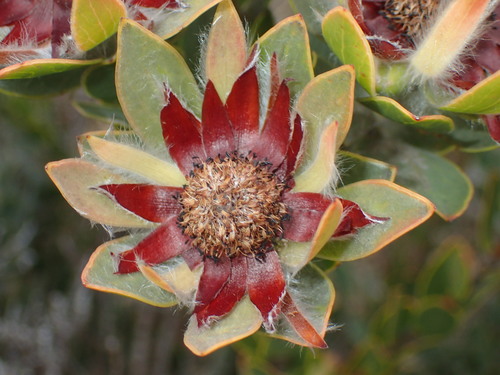
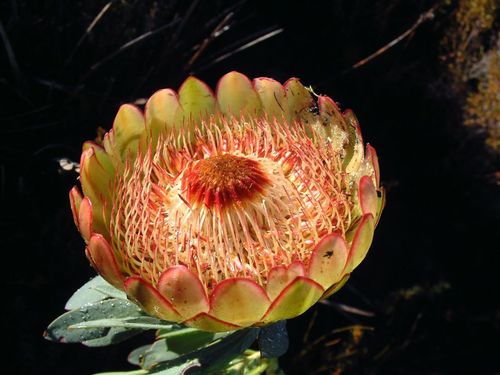
Branches of Protea effusa E.Mey. ex Meisn. are glabrous. Its leaves are glaucous, distinctly veined, mucronate, ending in an acute point and narrowing toward the base. Leaves are typically lanceolate in shape, and measure 1–2 inches (2.5–5.1 cm) long. The flower heads are sessile on the stems, 2–3 inches (5.1–7.6 cm) long and 3 inches (7.6 cm) in diameter, with a bowl shape. Flower heads appear on the plant during the winter months, and their bracts can range in color from greenish-yellow to deep red. This species occurs from the Koue Bokkeveld Mountains, including Waboomsberg, to the Du Toit Mountains and Naudesberg area of South Africa's Western Cape province. Within this range, it is found in the Franschhoek, Gydoberg, Hex River and Groot Winterhoek mountains. It grows almost exclusively on mountain summits. Existing populations have a fragmented spatial distribution and are small; over a quarter of all known populations consist of five or fewer individual plants, and the cause of these small population sizes is currently unknown. Only 13% of recorded localities host more than one hundred plants. This species grows on rocky, exposed mountain ridges in montane fynbos habitat at mountain tops, at altitudes between 1,200 and 1,800 metres. It is pollinated by rodents. Mature plants are killed by wildfire, but its seeds survive fire, as they are stored in fire-resistant dried old inflorescences. Seeds are released after fires and dispersed by wind.