About Leucospermum reflexum H.Buek ex Meisn.
Nomenclature and Growth Form
Leucospermum reflexum H.Buek ex Meisn., commonly called the rocket pincushion, is a large, rounded shrub that can reach up to 4 meters (13 feet) in diameter, growing from a single trunk at its base.
Bark Characteristics
Its branches are covered in smooth grey bark.
Flowering Stems
Flowering stems are stiffly upright, 3–6 mm (0.12–0.24 in) thick, and grey in color from a dense covering of fine twisted hairs pressed to their surface, with some additional long straight erect hairs.
Leaf Arrangement
Alternately arranged leaves point upwards at an angle to the branch.
Leaf Shape and Size
They are elliptic to inverted lance-shaped, only 2–5½ cm (0.8–2.2 in) long and ½–1¼ cm (0.2–0.5 in) wide, and also have a dense covering of fine twisted hairs pressed to the surface.
Leaf Tip Morphology
The tip of the leaf usually has two or three teeth, but may sometimes be entire.
Flower Head Position
Flower heads are produced individually near the ends of branches.
Flower Head Shape and Stalk
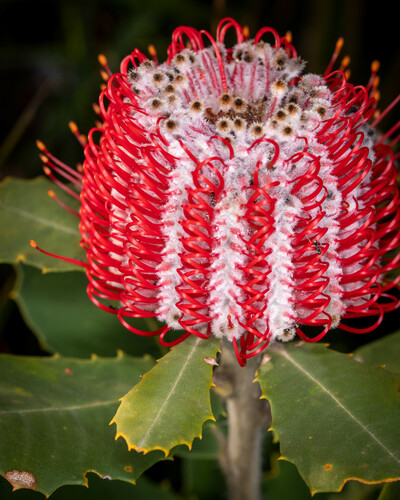
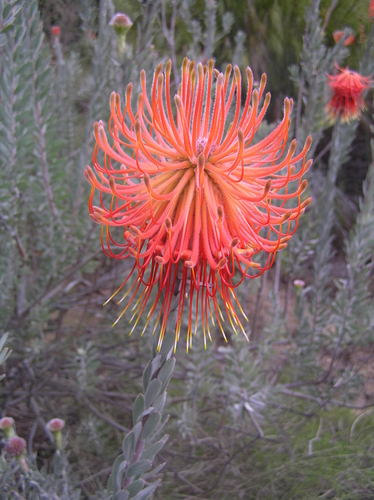
They are globe to egg-shaped when young, 8–10 cm (3.1–3.9 in) in diameter, growing on a 3–6 cm (1.2–2.4 in) long stalk.
Common Flower Base
The common base that supports all flowers in a single head is narrowly cylinder-shaped, 2–3½ cm (0.8–1.4 in) long and ½–¾ cm (0.2–0.3 in) thick.
Whole Flowerhead Bracts
The bracts subtending the whole flowerhead are narrowly triangular with a pointed tip, 1–1¼ cm (0.4–0.5 in) long and 4 mm (0.16 in) wide at the base, with a rubbery consistency, a sparse tuft of long hairs at the tip, and a row of hairs along its margin, similar to an eyelash.
Individual Flower Bracts
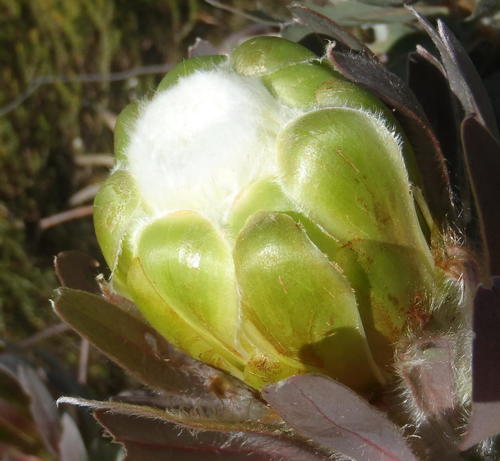
The bract subtending each individual flower tightly encloses the base of the perianth.
Individual Flower Bract Size and Shape
It is about 1 cm (0.4 in) long and 6–8 mm wide at its base, with a pointed tip that may curve outward.
Individual Flower Bract Hair Covering
It has thick woolly hairs at its base, and thinner, evenly spaced long straight hairs near the top.
Perianth Size and Color
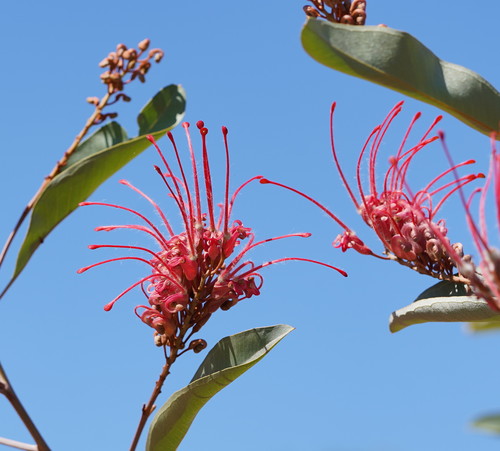
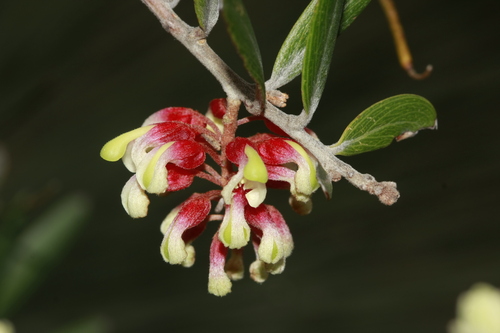
The perianth itself is 4–5 cm (1.6–2 in) long, most often crimson to deep orange, and very rarely pale yellow.
Perianth Tube
The lowest part of the perianth that remains fused after the flower opens, called the tube, is about 1 cm (0.4 in) long.
Perianth Tube Surface
It is hairless and narrow at the foot, and finely powdery and wider closer to the top.
Perianth Claws Hair Covering
The middle parts of the perianth that split when the flower opens, called claws, are uniformly covered in soft long hairs.
Perianth Claws Post-Opening Movement
They bend strongly immediately after the flower opens, forcing the style downward.
Perianth Limbs
The wider terminal parts of the perianth, called limbs, which cover the pollen presenter in the bud, are very narrowly lance-shaped to linear, 5–6 mm (0.20–0.24 in) long and about 1½ mm (0.06 in) wide with pointed tips, and are also covered in soft long hairs.
Perianth Claw Attachment
Three of the claws stay attached along their full length to form a sheath, while the fourth is free.
Perianth Limb Attachment
The limbs of all four perianth segments remain attached and are inrolled.
Anthers
Anthers attach directly to the perianth limbs without filaments, and are awl-shaped, 4–5 mm (0.16–0.20 in) long.
Style Size and Color
The style is 7–7½ cm (2.8–3.0 in) long.
Style Color Change
It is initially orange, and later becomes deep crimson; it is yellow in the rare pale yellow form.
Pollen Presenter
The pollen presenter is the same width as the style, white with greenish yellow near the tip, cylindric to awl-shaped with a sharp tip, 5–6 mm (0.20–0.24 in) long, with a very slight notch at its base.
Ovary Scales
The ovary, which is enclosed by the base of the perianth tube, is subtended by four awl-shaped, rubbery scales about 3 mm (0.12 in) long.
Taxonomy and Chromosome Number
The genus Leucospermum is placed in subtribe Proteinae, which consistently has a basic chromosome number of twelve, with 2n=24.
Distribution Range
L. reflexum is an endemic species found only in the eastern Cederberg mountains, ranging from Wupperthal in the south to Pakhuis Pass in the north.
Altitude and Rainfall Habitat
It grows at altitudes between 900 and 1800 m (3000–6000 ft), where annual rainfall is 250–380 mm (10–15 in), falling mostly in winter.
Specific Habitat and Associated Species
Because the regional climate is dry and this species prefers relatively moist conditions, it grows mainly in seepage areas or along streams, where it is often found growing alongside the reed-like restionid Cannomois virgata and common bracken Pteridium aquilinum.