About Protea acaulos (L.) Reichard
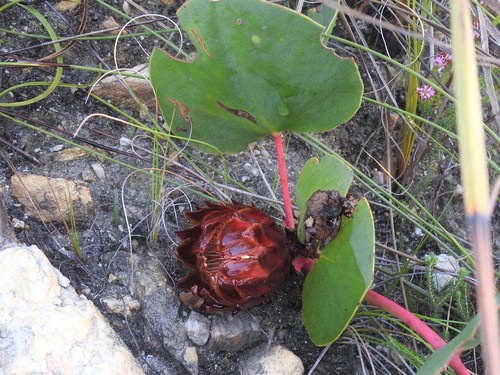
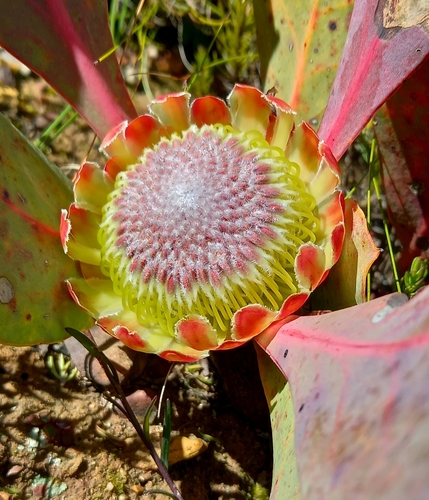
This species grows as a dwarf or creeping shrub, reaching a maximum height of about 30 cm, though some individuals only grow 7 cm tall. It can spread up to 1 m across. Its branches grow underground, and the plant forms densely packed tufts of leaves that emerge from the ground. It has a thick rootstock, and can re-sprout from this rootstock or other underground parts after wildfires destroy its above-ground growth. It is a very long-lived species; the total lifespan of three generations of this plant is estimated to be between 150 and 300 years. This plant is monoecious, meaning each individual flower contains both male and female reproductive structures. It blooms in spring, from June to November. Protea acaulos is endemic to the Western Cape province of South Africa, where it is widespread across the province. It occurs on the Cape Peninsula in the southwest, growing on flats north to the Cederberg in the northwest, extending east to the Elim Flats on the Agulhas Plain, the Caledon Swartberg, the Riviersonderend Mountains, and as far east as Bredasdorp. A small, isolated, disjunct population also grows on the Langeberg Mountains near Barrydale. It occurs at low population densities, and solitary plants are commonly found. It belongs to the "acid sand fynbos complex" of plants, and is adapted to regular wildfires. It grows at altitudes ranging from sea level up to 1,500 or 1,800 metres. It prefers sandy and alluvial soils on flats or lower slopes of lowland or mountain fynbos, but can also be found growing in shale and granite fynbos. Its flowers are pollinated by rats, mice, and birds. Its seeds are stored in dried, fire-resistant inflorescences (seedheads) that stay attached to the plant. Seeds are only released one to two years after flowering, following a fire, and are dispersed by wind.