About Prostanthera striatiflora F.Muell.
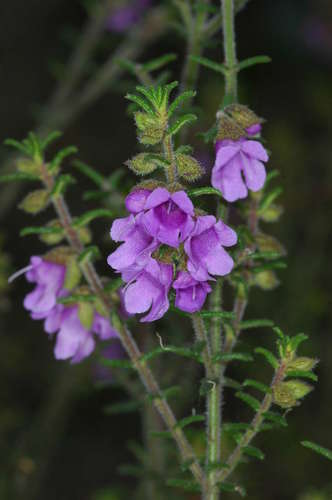
Prostanthera striatiflora is an erect, aromatic shrub that usually grows between 0.5 and 2 meters (1 foot 8 inches to 6 feet 7 inches) tall, and has only sparsely hairy branches. Its leaves are narrow egg-shaped to narrow elliptic, ranging from 8 to 39 millimeters (0.31 to 1.54 inches) long and 2 to 10 millimeters (0.079 to 0.394 inches) wide. Most leaves are glabrous, and are either sessile or borne on a petiole up to 1 millimeter (0.039 inches) long. Flowers are arranged in groups of four to around twelve near the ends of branchlets, with each flower sitting on a pedicel 1.3 to 2.3 millimeters (0.051 to 0.091 inches) long. The sepals are light green, often with a faint purple tint, and form a tube 2.5 to 3.4 millimeters (0.098 to 0.134 inches) long with two lobes that are 2.3 to 3.9 millimeters (0.091 to 0.154 inches) long. The petals are white, 10 to 17 millimeters (0.39 to 0.67 inches) long, and form a tube 10.3 to 11.4 millimeters (0.41 to 0.45 inches) long marked with purple lines on the inside. The middle lower petal lobe is spatula-shaped, 6.5 to 10 millimeters (0.26 to 0.39 inches) long and 8.5 to 9 millimeters (0.33 to 0.35 inches) wide, while the side lobes are 5 to 8.5 millimeters (0.20 to 0.33 inches) long. The upper petal lip is 5.5 to 10.5 millimeters (0.22 to 0.41 inches) long and 8.5 to 13.8 millimeters (0.33 to 0.54 inches) wide, with a central notch 3 to 4.5 millimeters (0.12 to 0.18 inches) deep. Flowering occurs between July and November. This species, commonly called jockey's cap, grows in arid areas of New South Wales, Queensland, Western Australia, South Australia and the Northern Territory, where it occurs in woodland on rocky, dry terrain. In horticulture, Prostanthera striatiflora is cultivated for its showy flowers and aromatic foliage. It grows best in a well-drained location in full sun or partial shade, tolerates both dry conditions and frost, and is suitable for growing in large containers.