About Prostanthera cuneata Benth.
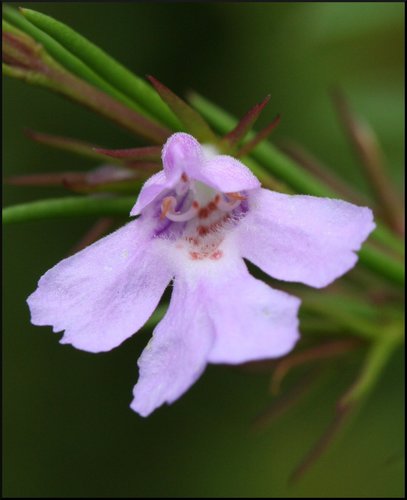
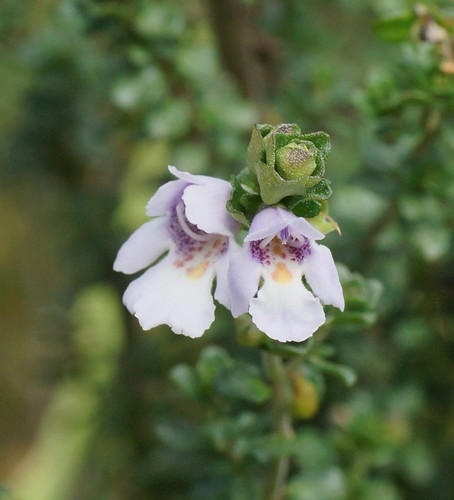
Prostanthera cuneata Benth. is most commonly an erect, roughly compact shrub that grows 0.5 to 1.5 meters (1 foot 8 inches to 4 feet 11 inches) tall, but often becomes prostrate as it ages. Its branches are roughly cylindrical and covered with white hairs. The leaves of this species are strongly aromatic when crushed. They are egg-shaped with the wider end oriented away from the stem, often appearing wedge-shaped, measuring 4–6 mm (0.16–0.24 in) long and 3.5–5 mm (0.14–0.20 in) wide. Leaves are either sessile or borne on a petiole no more than 0.5 mm (0.020 in) long. Flowers are arranged singly in 4 to 10 leaf axils near the ends of branchlets, with each flower held on a 1–2 mm (0.039–0.079 in) long pedicel. The sepals are green, usually tinged with purple, and form a tube 2.5–3 mm (0.098–0.118 in) wide that has two lobes. The lower sepal lobe measures 3–4.5 mm (0.12–0.18 in) long, while the upper lobe measures 2.5–4 mm (0.098–0.157 in) long. The petals range in color from pale lavender to almost white, with reddish or purple blotches inside the petal tube. They are 9–15 mm (0.35–0.59 in) long overall, forming a tube 6–8 mm (0.24–0.31 in) long. The lower central petal lobe is 6.5–9 mm (0.26–0.35 in) long, and the upper petal lobes are 5–6 mm (0.20–0.24 in) long, with a 1–2 mm (0.039–0.079 in) long central notch. Flowering occurs from November through April. This species, commonly called alpine mint bush, grows in alpine and subalpine closed heath and shrubland on granite-based soils in New South Wales and Victoria, and is often found growing alongside snow gums (Eucalyptus pauciflora). In Tasmania, Prostanthera cuneata is listed as "presumed to be extinct" under the Tasmanian Threatened Species Protection Act 1995. In New South Wales, it occurs south of the Brindabella Range; in north-eastern Victoria, it grows at altitudes between roughly 1,500 and 2,000 m (4,900 and 6,600 ft). When cultivated, this plant has earned the Royal Horticultural Society's Award of Garden Merit. It holds an RHS hardiness rating of H4, meaning it is hardy through most of the United Kingdom, tolerating temperatures down to -5° to -10 °C, and is suited to USDA hardiness zones 8 to 9.