About Procavia capensis (Pallas, 1766)
Body Build and Weight
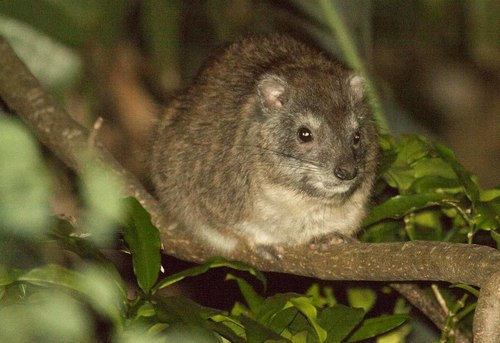
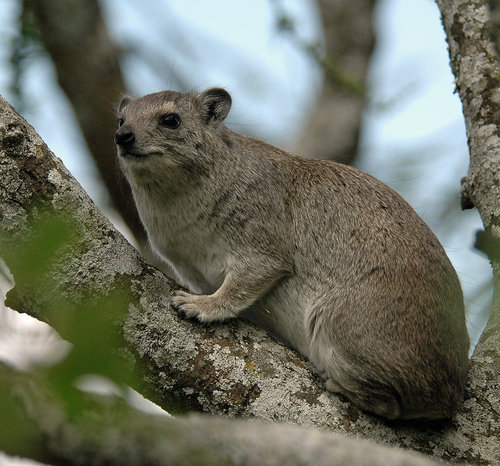
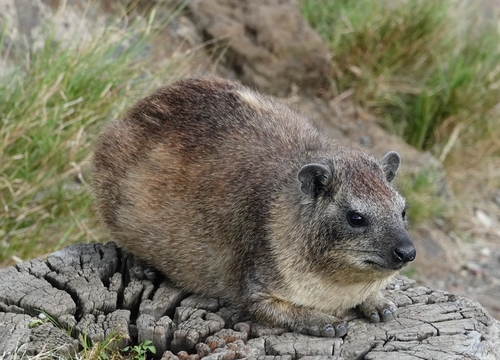
Characteristics: Rock hyraxes (Procavia capensis) are squat and heavily built. Adults reach 50 cm (20 in) in length and weigh around 4 kg (8.8 lb), with slight sexual dimorphism: males are roughly 10% heavier than females.
Fur Coloration
Their fur is thick and grey-brown, though color varies strongly across different environments: individuals from wetter habitats are dark brown, while desert-living individuals are light gray.
Body Size and Precipitation Correlation
Hyrax body size, measured by skull length and humerus diameter, correlates with precipitation, likely due to precipitation’s effect on their preferred forage.
Dorsal Gland Function
A prominent dorsal gland that excretes odor for social communication and territorial marking is apparently unique to hyraxes, and this gland is most clearly visible in dominant males.
Head and Facial Features
The rock hyrax has a pointed head, short neck, rounded ears, and long black whiskers on its muzzle.
Incisor Structure
It has a prominent pair of long, pointed tusk-like upper incisors that resemble the incisors of elephants, to which hyraxes are distantly related.
Foot Morphology
Their fore feet are plantigrade, and their hind feet are semi-digitigrade. The soles of their feet have large soft pads kept moist with sweat-like secretions.
Male Anatomical Trait
In males, the testes are permanently located in the abdomen, an anatomical trait that hyraxes share with elephants and sirenians.
Thermoregulation Rhythm
Thermoregulation in rock hyraxes has been heavily studied, because their body temperature follows a diurnal rhythm. This temperature variation persists even in individuals kept in constant environmental conditions, and this internal rhythm may be linked to water balance regulation.
Overall Species Distribution
Distribution and geographic variation: The rock hyrax has a wide range across sub-Saharan Africa, split into disjunct northern and southern populations. It is absent from the Congo Basin and Madagascar. Its distribution also includes southern Algeria, Libya, Egypt, and the Middle East, with populations in Israel, Jordan, Lebanon, and the Arabian Peninsula.
Introduced Population Range
The northern subspecies has been introduced to Jebel Hafeet, located on the border of Oman and the United Arab Emirates.
Pelt Color Variation
Pelt shade varies both individually and regionally.
Dorsal Patch Color Variation
In particular, the dorsal patches present in both sexes of central populations are highly variable, ranging from yellow to black, or appearing flecked. In outlying populations, these patches have more consistent color: black in P. c. capensis, cream in P. c. welwitschii, and orange in P. c. ruficeps.
Mount Kenya Alpine Population
A larger, longer-haired population is abundant in the moraines of Mount Kenya’s alpine zone.
Dwelling Habitat
Ecology and behavior: Rock hyraxes build dwelling holes in any type of rock that provides suitable cavities, including sedimentary rocks and soil.
Colony Structure and Activity
On Mount Kenya, rock hyraxes live in colonies made up of one adult male, several adult females, and immature individuals. They are active during the day, and sometimes active during moonlit nights. The dominant male defends the group, watches over it, and marks his territory.
African Predators
In Africa, hyraxes are preyed on by leopards, Egyptian cobras, puff adders, rock pythons, caracals, wild dogs, hawks, and owls. Verreaux's eagle is a specialist hunter of hyraxes in particular.
Middle East Predation Risk
In the Middle East, the rock hyrax is reportedly rarely hunted by terrestrial predators, since its system of sentries and reliable refuges provide substantial protection. Hyrax remains are almost never found in the droppings of wolves in the Judean Desert.
Gestation and Birth Traits
Reproduction: Rock hyraxes give birth to two to four young after a 6–7 month gestation period, which is long for an animal of their size. The young are well developed at birth, with fully opened eyes and a full coat of fur.
Juvenile Development
Young can eat solid food after two weeks and are weaned at 10 weeks. They become sexually mature after 16 months, reach adult size at 3 years, and typically live around 10 years.
Male Reproductive Seasonality
The weight of male reproductive organs (testes and seminal vesicles) changes with seasonal shifts, tied to sexual activity. In Cape Province, South Africa, males are sexually inactive between May and January. Starting in February, the weight of these organs increases dramatically, and males become able to copulate.
Hyraceum Production
Naturopathic use: Rock hyraxes produce large amounts of hyraceum, a sticky mass of dung and urine.
Hyraceum Applications
This substance has been used as a South African folk remedy to treat several medical disorders, including epilepsy and convulsions. Today, perfumers use hyraceum, tincturing it in alcohol to create a natural animal musk.