About Heterohyrax brucei (Gray, 1868)
Physical Adaptations Overview
The bush hyrax (Heterohyrax brucei) has multiple specialized physical adaptations.
Foot Structure & Grip
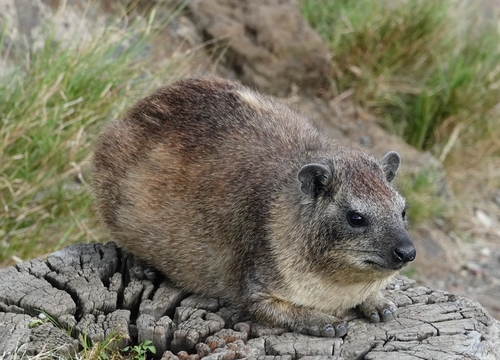
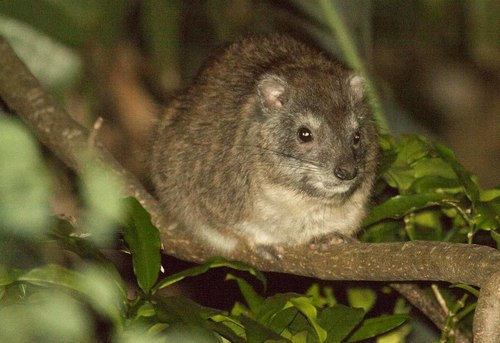
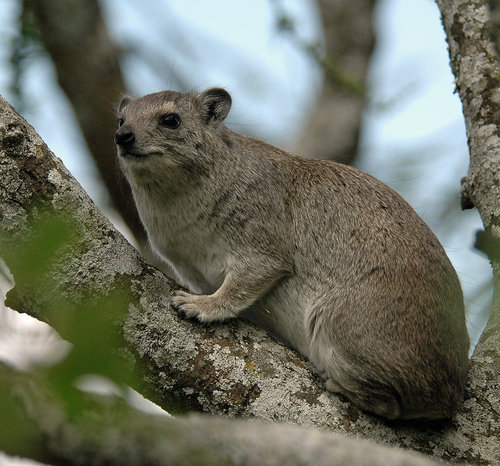
It has specialized glands on the pads of its feet that secrete moisture to keep the flat, hairless foot pads moist, which increases grip for navigating smooth rock surfaces. Foot muscles contract the foot into a cup-like shape that creates a suction cup effect, making the species an excellent climbers; it has even been observed that shot bush hyraxes remain stuck perpendicular to rock surfaces. The forepaw has three well-developed digits, a rudimentary thumb, and a small fifth digit. All digits have flat, hoof-like nails, except the second digit, which has a long, curved claw used for grooming. The hind paw follows a similar structure, but lacks a big toe and has a rudimentary fifth digit.
Sensory & Renal Traits
A bush hyrax's eye has an umbraculum in the pupil that extends from the iris, allowing it to stare directly into the sun while sunbathing to watch for aerial predators. It also has a specialized kidney that compensates for limited water in its natural habitat, letting it conserve water by producing highly concentrated urine. This concentrated urine leaves a crystalline residue called klipstreet or hyraceum, which is commonly found on the rock outcroppings where the species lives.
Geographic Distribution
Bush hyrax populations are native to Africa. Their range extends north to Sudan and Eritrea, covers the entire Horn of Africa to the east, and reaches south to Limpopo Province in South Africa. Isolated populations also live in the southwest of the Democratic Republic of Congo and Angola.
Preferred Habitat
The species is restricted to rocky habitats including rocky kopjes (elevated rocky outcrops on generally flat plains), sheer rock faces called krantzes, and piles of large boulders. They occupy openings with at least 1 m² of space and 11 cm in height. These rocky habitats suit them because they have many crevices for nesting and sheltering from weather and predators. Bush hyraxes live at elevations ranging from sea level up to 3,800 m.
Colony Social Structure
They live in colonies that can sometimes number hundreds of individuals, with population densities between 20 and 53 individuals per hectare. Their family units are polygynous, usually holding 5 to 34 animals: one dominant male, 3 to 7 females, and many juvenile individuals of both sexes. Other adult males live on the periphery of dominant males' territories.
Population Decline Causes
Since 1978, bush hyrax populations in Zimbabwe's Matobo National Park have experienced considerable decline. Droughts in the park are considered a cause of this decline, and predation is also reported to be high in the region, with a 52–61% mortality rate recorded for bush hyraxes within their first year of life.
Rock Hyrax Cohabitation
Bush hyraxes are known to cohabitate with rock hyraxes (Procavia capensis and Procavia johnstoni), but the two species do not interbreed because their sex organs differ significantly. The species have been observed sharing nurseries to care for each other's young and inhabiting the same rock crevices. This association between the species varies, and in Zimbabwe they often overlap in habitats near the time of parturition (giving birth).
Lifespan & Sexual Maturity
Bush hyraxes can live over 10 years in the wild, with an average lifespan of 12 years. Both males and females reach sexual maturity between 16 and 17 months of age. Sexually mature females breed annually, and breeding seasons vary by geographic location.
Regional Breeding Patterns
Peak births occur between February and March in Kenyan colonies, in March in Zimbabwe, and between December and January in the Serengeti, Tanzania. Gestation lasts 7–8 months, so breeding seasons occur 7–8 months before these peak birth periods. Females in colonies at high elevation enter estrus as photoperiod increases, and their estrus cycle lasts 1–5 days. In the Serengeti, there is a discrete seven-week mating season where females enter estrus multiple times for several days each time. This synchronizes births across the colony, with all breeding females giving birth within three weeks of each other.
Offspring Traits & Weaning
Litter size ranges from 1 to 3 young, averaging between 1.6 and 2.1 depending on location. Newborn bush hyraxes weigh 220 to 230 g, are born open-eyed and fully furred, and are able to follow adults out of the nest within several hours of birth. Young are suckled for 1–6 months before weaning.
Juvenile Mortality Rates
Juvenile mortality is high due to predation; predators include rock pythons, leopards, birds of prey, mongooses, and other small carnivores. A study conducted between 1992 and 1995 estimated annual juvenile mortality at 52.4–61.3%.