About Proboscidea althaeifolia (Benth.) Decne.
Nomenclature and Common Names
Proboscidea althaeifolia (Benth.) Decne. is a species of flowering plant in the Martyniaceae family, commonly known as desert unicorn-plant and yellow-flowered devil's claw.
Distribution, Habitat, and Flowering Season
It is native to the desert southwest of the United States, where it grows in sandy habitats and blooms during the hot summer.
Growth Form and Root Structure
This species is a perennial herb that grows from a thick, tuber-like yellow root.
Stem Morphology
Its stem is decumbent, meaning it creeps along the ground.
Leaf Characteristics
The shiny leaves have blades that are rounded, oval, or roughly triangular, reaching up to 7 centimeters long; the blades are deeply lobed with wavy edges.
Inflorescence and Flower Shape
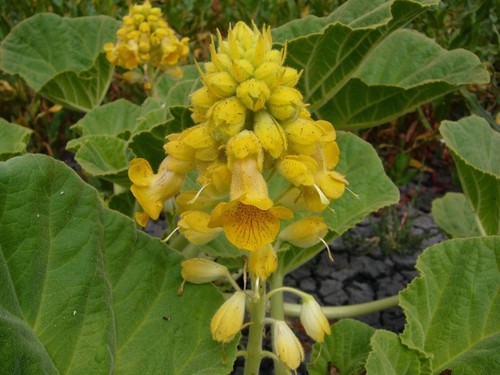
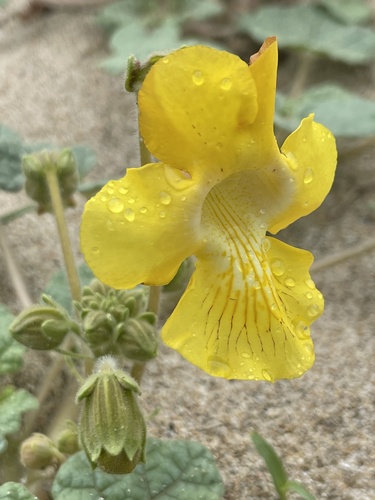
The inflorescence is an array of many showy, fragrant, bell-shaped flowers, with five lobes that flare several centimeters wide.
Flower Coloration and Markings
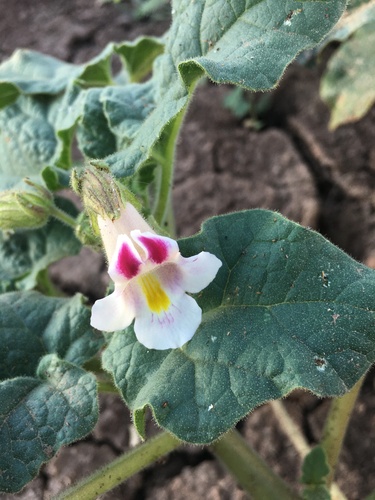
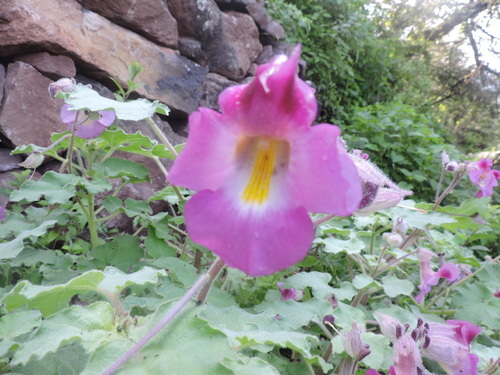
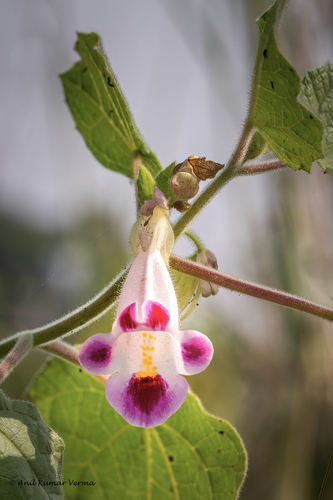
Flowers are yellow to orange or apricot, with an intricate pattern of speckles and streaks, and the lower lobe is lined with a nectar guide.
Fresh Fruit Morphology
The fruit is a large seed pod many centimeters long, consisting of a cylindrical body that tapers into a very long, thin, curving tail.
Dry Fruit Structure
As the fruit dries, the tail cracks open and splits into two hooked, claw-like halves.
Traditional Human Use
These hard, dry fruits were used as tools by local Native Americans.