About Martynia annua L.
Nomenclature and Growth Form
Martynia annua L., commonly known as cat's claw or tiger's claw, is an erect, somewhat shrubby annual that grows to around 1 metre (3.3 ft) tall. The entire plant is covered in glandular hairs.
Leaf Characteristics
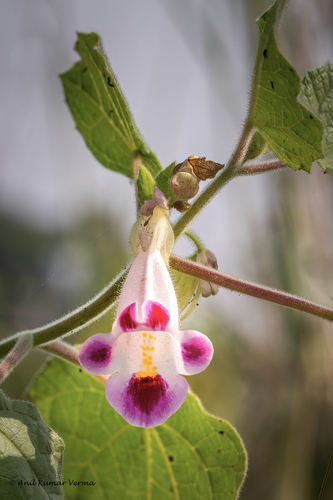
Its leaves are opposite, ovate, and mucilaginous, measuring 6–19 centimetres (2.4–7.5 in) long and 8–20 centimetres (3.1–7.9 in) wide, with red petioles, and their texture and appearance resemble sticky rhubarb.
Flower Appearance
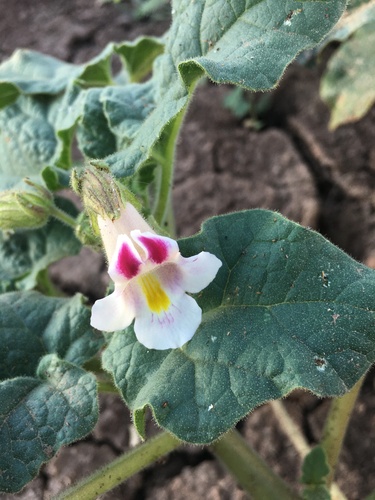
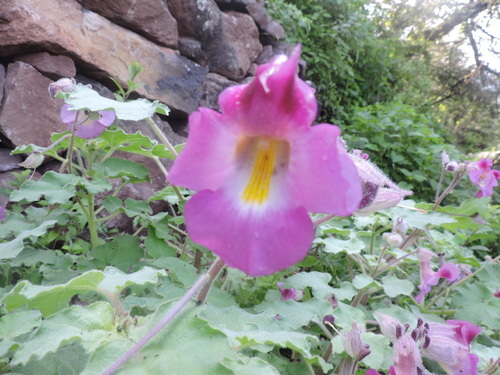
The species produces pale pink, tubular flowers marked with nectar guides and purple spots.
Fruit Morphology
When ripe, its fruits turn black and bear hooked spines at their tip, which gives the plant its common names.
Seed Dispersal Mechanism
These hooked spines allow fruits to stick to animal fur; seeds are eventually released when the fruit is crushed under the animal's feet.
Species Distribution
This species is widely naturalized across subtropical and tropical regions of the world, with prominent occurrences in Central America and the Indian subcontinent.
Habitat and Elevation Range
It usually grows in uncultivated fields and arable lands, at elevations ranging from plains up to 1,500 metres (4,900 ft).
Ornamental Use
The plant is used to make beads and other traditional indigenous ornaments.
Medicinal Uses
It has been used for a wide range of purported medicinal treatments in the Ayurveda and Siddha folk medicine systems.