About Premna serratifolia L.
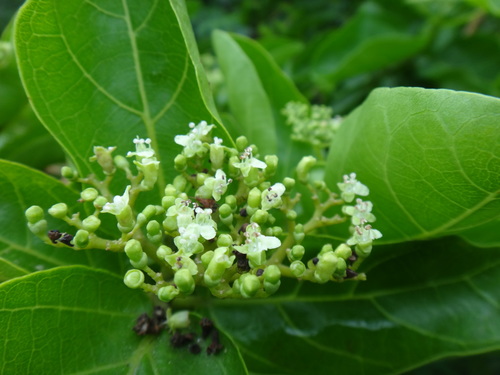
Premna serratifolia L. is a tree species that grows up to 7 meters tall. It has simple, opposite, estipulate leaves. The leaf petiole is 4 to 14 mm long, slender, pubescent, and grooved along the upper surface. The leaf blade measures 2.5–8.5 cm by 2–7.2 cm, and is elliptic or elliptic-oblong in shape. The leaf base can be acute, obtuse, subcordate, or rounded, while the leaf apex is acuminate, mucronate, or obtuse. Leaf margins are either entire or subserrate. The upper leaf surface is glabrous except along the appressed midrib, and the leaf tissue is chartaceous. It has 3 to 5 pairs of pinnate lateral nerves that are prominent, and puberulous on the lower leaf surface. The intercostal veins are reticulate and obscure. The species produces bisexual, greenish-white flowers arranged in terminal corymbose panicled cymes. It has small bracts, a small campanulate calyx that is two-lipped and five-lobed. The corolla has a short tube that is villous on the inside, and five lobes. There are four didynamous stamens inserted below the throat of the corolla tube, with ovate anthers. The ovary is superior, with 2 to 4 cells and 4 ovules total. The style is linear, and the stigma is shortly bifid. The fruit is a globose purple drupe that sits on the calyx, and produces oblong seeds. This plant most often grows in moist sandy soil and scrub jungles along seacoasts, as well as in mangrove forests. In the Philippines, specifically on Cebu Island, it is commonly found in the interior, watery forests of Southern Cebu. The plant is widely used in Indian traditional medicine. Studies of the root wood of P. serratifolia have resulted in the isolation of acteoside, a glucoside derivative. The root bark of the plant, which shows biological activity, also contains a potent cytotoxic and antioxidant diterpene: 11,12,16-trihydroxy-2-oxo-5-methyl-10-demethyl-abieta-1[10],6,8,11,13-pentene. In Vietnam, the aromatic leaves of P. serratifolia are used for cooking in braised or stir-fried dishes prepared with chicken, eels, or frogs.