About Prangos ferulacea (L.) Lindl.
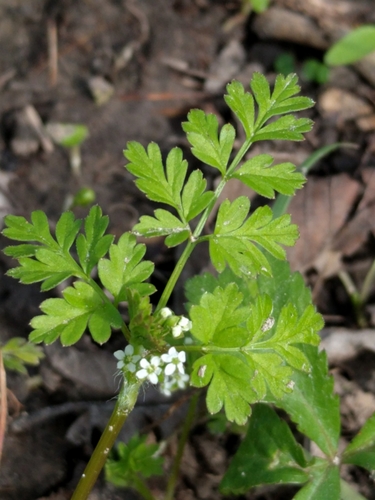
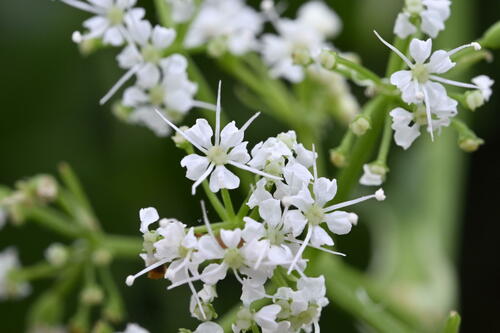
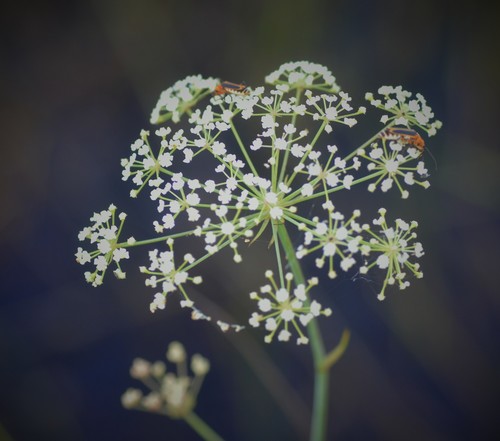
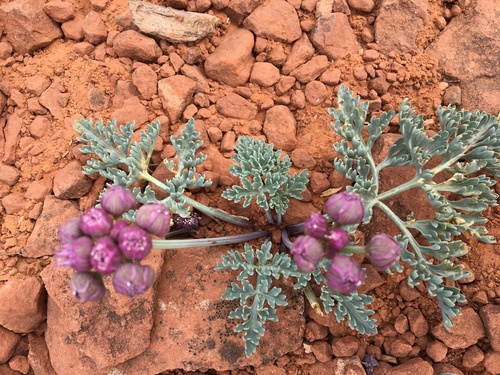
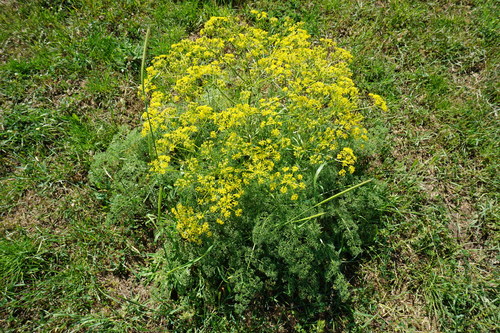
Prangos ferulacea (L.) Lindl. is a herbaceous plant that reaches 60–150 cm in height, with a stem that measures 1–2 cm in diameter at its base. Its leaves are glabrous, light green, and range in shape from broadly ovate to ovate-triangular or oblong-elliptic, and are repeatedly pinnate. Basal leaves have petioles up to 50–80 cm long, and are divided into 3 lobes at the base; each lobe is pinnately divided 4–5 times. The terminal leaf lobes are linear, lanceolate, or almost filiform, have a single vein, and end in a short point. Lower stem leaves have shorter stalks, while the uppermost stem leaves are sessile, much smaller, less dissected, and have sheaths that enclose the stem. The plant produces complex umbels around 15 cm in diameter, with 6–18 main rays, and a sheath of linear-lanceolate, membranous leaves at the base of the umbel. Awns are around 1 cm wide. Petals are around 1 mm long, and obovate or elliptic in shape. Fruits measure 10–25 mm long, around 10 mm wide, are ovoid to elliptical, and slightly flattened laterally. This species blooms from May to June and produces fruit from June to August. It is pollinated by insects and reproduces via seed propagation. This species is distributed in Italy (including the island of Sicily), Romania, Bulgaria, the Caucasus, Turkey, Armenia, and Iran. In Bulgaria, it occurs along the Black Sea coast at Medni Rid and Maslen nos, as well as in Bakadzhitsite, growing up to around 300 m above sea level. It is classified as an endangered species in Bulgaria, and is included in the Red Book of Bulgaria and the Bulgarian Law on Biological Diversity. In northern Sicily, it grows on limestone in association with the endangered fungus Pleurotus nebrodensis.