About Poyntonia paludicola Channing & Boycott, 1989
Body Form
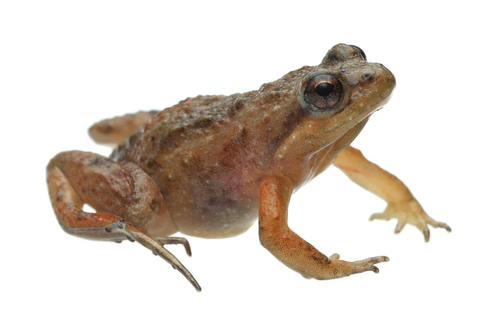
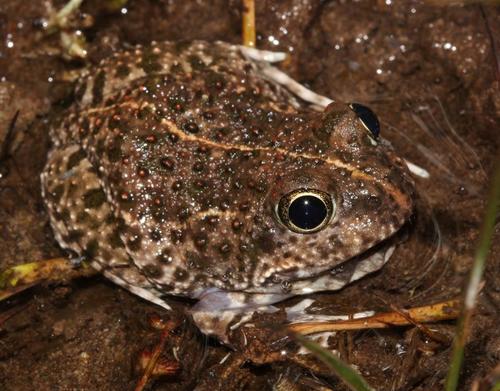
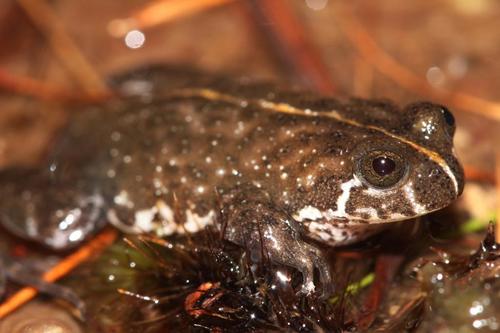
Poyntonia paludicola resembles bufonids because of its stout body form and warty outward appearance.
Body Size
Adult individuals reach a body length of 27 to 30 mm, and females grow larger than males.
Tympanum Characteristics
The tympanum is not visible on this species.
Limb Structure
The fingers have slight webbing, while the toes are long and lack discs.
Body Wart Coverage
Most of the frog's body is covered in warts. A raised mass of warty skin is present behind each of its eyes.
Dorsal Markings
Most individuals have a red-orange stripe running along the vertebra, and most also have a long white teardrop-shaped mark that extends from the bottom of the eye toward the top of the arm.
Ventral Coloration
The belly is pale, and often has unevenly distributed dark blotches.
Male Advertisement Call
The male advertisement call of this species is made up of 1 to 6 brief, low-pitched chirps at a rate of roughly three chirps per second, and sounds like a unique coarse "kruck-kruck-kruck".
Egg Characteristics
Relative to the adult body size of the species, its eggs are fairly large.
Observed Clutch Details
One clutch laid in September 2020 held 15 eggs, which were deposited at the edge of a seepage pool in 2 cm of muddy water.
Morphological Similarities
In terms of morphology and the relative size of eggs and larvae, Poyntonia paludicola shares many similarities with Capensibufo, a genus of small montane toads that uses similar habitat and occurs in sympatry with P. paludicola.
Habitat Vegetation
Poyntonia paludicola lives in montane fynbos, a Mediterranean-type shrubby vegetation, in regions that receive high annual rainfall between 2,000 and 3,000 mm.
Elevational Range
Its elevational range extends from sea level up to 1800 meters above sea level.
Breeding Habitat
These frogs breed in shallow puddles connected to seepage areas, and these seepages often have some amount of water flow.
Habitat Threats
Threats to the species' habitat include encroachment by alien vegetation, water abstraction, and disruption of natural fire regimes.
Protected Populations
Most populations of Poyntonia paludicola are found within protected areas, including the Kogelberg Biosphere Nature Reserve, Hottentots Holland Nature Reserve, and Fernkloof Nature Reserve.