About Amietia fuscigula (Duméril & Bibron, 1841)
Common and Scientific Name
Commonly called the Cape river frog, this species has the scientific name Amietia fuscigula (Duméril & Bibron, 1841).
Size
It is a fairly large typical frog, with a maximum snout-to-vent length of around 125 mm.
Body and Hind Limb Morphology
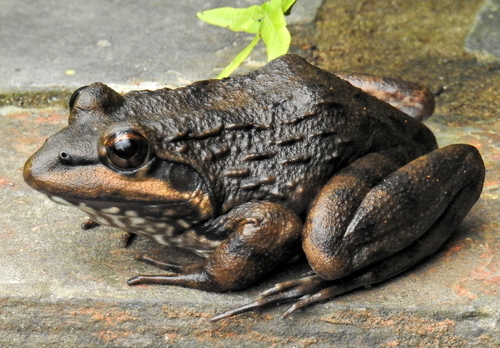
Its snout is slightly rounded, and it has a powerful athletic build with long webbed hind legs and feet that are well adapted for both leaping and powerful swimming. The forefeet are not webbed. When the frog rests on a level surface, the tip of its longest rear toe reaches directly below its tympanum.
Ventral Skin and Etymology
Its ventral skin is smooth and white, with dark mottling on the throat; this mottling is the origin of the specific epithet fuscigula, which means "dusky throated" in Latin. In some individual frogs, the mottling extends onto the belly.
Dorsal Skin Texture
Its dorsal skin has a light scattering of small rounded protuberances and sections of longitudinal ridges.
Dorsal Coloration
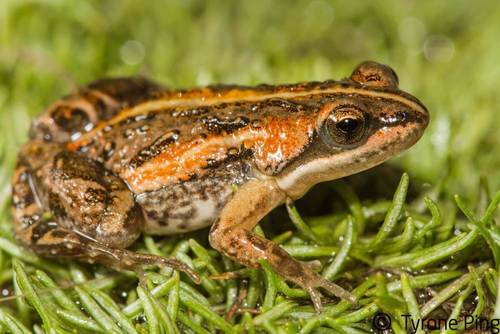
Cape river frog colouration is highly variable, ranging from dark to light brown, and it is also commonly green, olive, or marked with green streaks. The back and limbs are more or less noticeably blotched with darker irregular spots.
Sexual Dimorphism
There is little noticeable sexual dimorphism, but breeding-season males develop a dark, swollen nuptial pad on each thumb.
Eye and Tympanum Features
Both the eye and tympanum are prominent, and the tympanum's diameter is only slightly smaller than that of the eye.
Breeding Habitat Requirement
The Cape river frog inhabits a wide variety of temperate to tropical habitats, as long as there is at least seasonal access to fresh water for breeding.
Occupied Habitat Types
Habitats it occupies include arable land, pastureland, savanna, shrubland, fynbos, grassland, rivers, swamps, freshwater lakes, marshes, springs, water storage areas, ponds, dams, and sewage treatment areas. They sometimes even live and breed in domestic water containers, such as water butts or horse troughs.