About Potorous tridactylus (Kerr, 1792)
Taxonomic Classification
The long-nosed potoroo (Potorous tridactylus) is a small, hopping marsupial mammal that belongs to the potoroo and bettong family Potoroidae, and is native to forests and shrubland of southeastern Australia and Tasmania. It is a solitary nocturnal animal that digs to find fungi, roots, and small insects for food.
Reproductive Trait
Like other marsupials such as kangaroos, female long-nosed potoroos carry their young in a pouch.
Subspecies
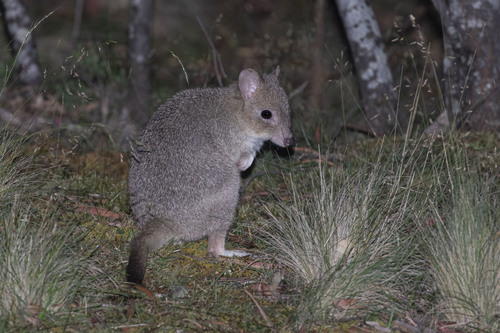
There are two recognized subspecies: P. t. tridactylus from mainland Australia, and P. t. apicalis from Tasmania, which has lighter fur.
Visual Similarity to Bandicoot
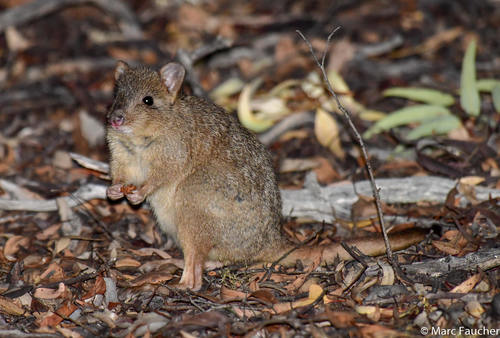
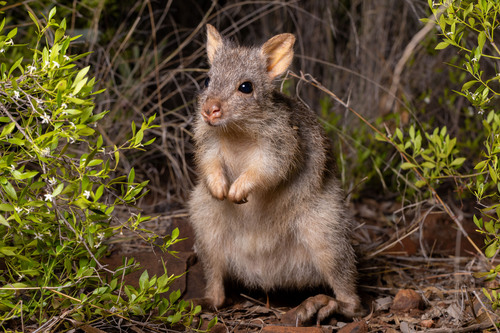
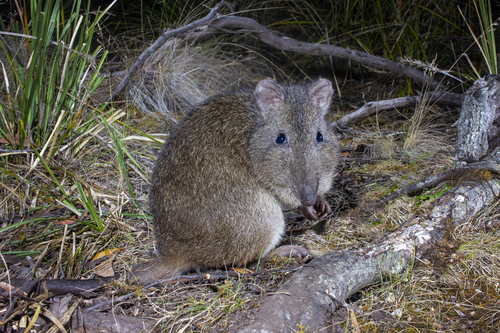
At first glance, the long-nosed potoroo with its pointed nose and grey-brown fur closely resembles a bandicoot. This resemblance ends when the potoroo hops away with its front feet tucked against its chest, which reveals its close relationship to the kangaroo family.
Morphological Specializations
The species has several distinct morphological specializations: an elongated pointed nose, erect ears, large eyes, digging claws, and long, strong hind legs.
Size Measurements
As a small marsupial, it has a body length between 34 and 38 cm (13–15 in), and a semi-prehensile tail that measures 15 to 24 cm (5.9–9.4 in) in length.
Field Presence Signs
The long-nosed potoroo is rarely seen in the wild; clearer signs of its presence are the worn paths (runways) it creates through undergrowth, and the hollow diggings it leaves behind while feeding on underground roots and fungi.
Current Distribution
On the Australian mainland, the long-nosed potoroo occurs in a range of microhabitats in the Southern Highlands of New South Wales and South-Western Victoria, and it is also found across Tasmania. Fossil bones of the species recovered from cave deposits show that it had a much wider distribution historically than it does today.
Occupied Vegetation Types
It can occupy a variety of vegetation types: these include subtropical and warm temperate rainforest, tall open forest with dense understorey, and dense coastal heaths.
Habitat Requirements
Its key habitat requirement is thick groundcover, which it uses for protection from threats and to build nests. It also prefers light, easily dug soils that let it access the underground roots and fungi that form part of its diet.
Home Range Size
Home range sizes for the long-nosed potoroo vary widely; the largest home range ever recorded was 34.4 hectares (85 acres). In Tasmania, recorded home ranges are large overlapping areas of 5–20 hectares (12–49 acres), and males typically hold larger home ranges than females. Home ranges in Victoria are much smaller than those recorded in Tasmania.
Threats
The species is currently threatened by habitat loss and introduced species including cats and foxes.