About Bettongia penicillata Gray, 1837
Common Name and Taxonomy
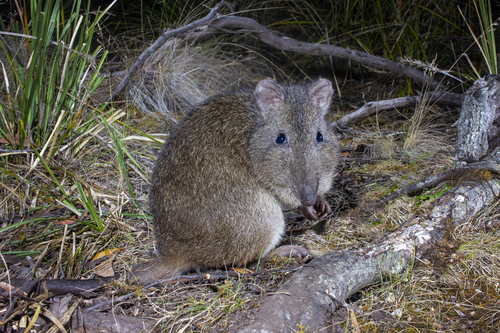
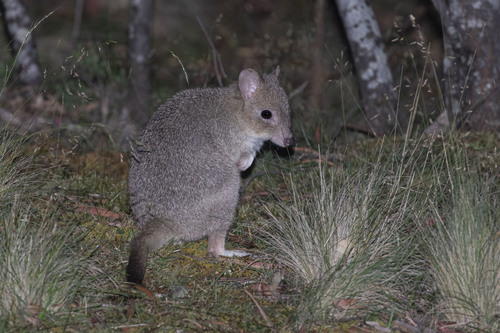
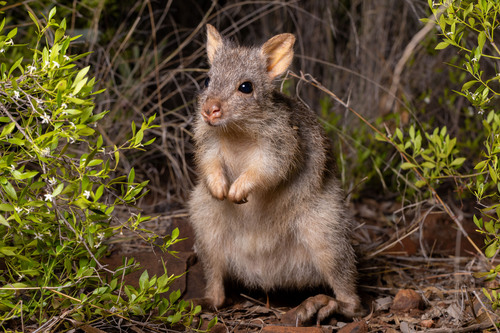
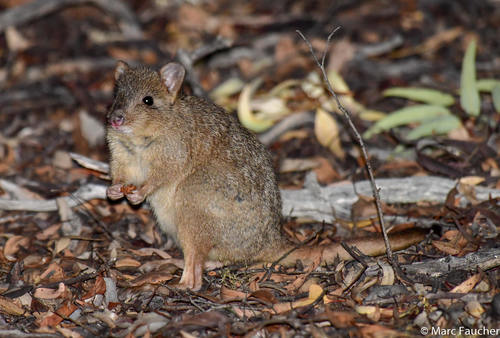
Bettongia penicillata, commonly known as the woylie, is a species of potoroine marsupial.
Foraging and Home Range
It forages for fungi by digging during the night, and typically maintains a solitary home range centered around a central nest.
Head and Body Length
The combined head and body length of this species ranges from 310 to 380 millimetres (12 to 15 in).
Body Fur Coloration
The entire body is covered in fur: the back is grey-brown, the face, thigh, and flank are buff-colored, and the underparts fade to pale cream.
Silvery hairs are interspersed through the grey-brown fur of the upper body.
Tail Structure and Color
The tail is roughly the same length as the head and body, measuring 290 to 350 mm (11 to 14 in); it is rufous brown and ends in a blackish tip.
A ridge of longer fur runs along the upper side of the slightly prehensile tail.
Average Measurements
The average head-body length is 330 mm (13 in), average tail length is 310 mm (12 in), and average weight is 1,300 grams (46 oz).
Similar Species Comparison with Boodie
The species resembles the burrowing boodie (Bettongia lesueur), but the woylie has distinctly paler ventral fur, and lacks the blackish tail coloration of the boodie.
The woylie has a pale ring around its eye, and a longer, more pointed muzzle than the boodie.
Similar Species Comparison with Gilbert's Potoroo
Its muzzle is shorter than that of Gilbert's potoroo (Potorous gilbertii), a species with which it once shared an overlapping distribution range.
Historical Habitat Range
Historically, the woylie occupied a wide range of habitats, including low arid scrub and desert spinifex grasslands.
20th Century Persistence in South-West Australia
A population in south-west Australia persisted into the 20th century, surviving the mass extinction event that eliminated similar mammal species in preceding decades.
Early 20th Century Specimen Collections
Specimens were collected from temperate sites near Margaret River by G. C. Shortridge in 1909, and by Charles M. Hoy in 1920.
1930s Population Decline and Red Fox Introduction
The last collections of wild woylies from the King George Sound and Denmark regions of Western Australia were made in the 1930s, which coincided with the first records of the introduced red fox (Vulpes vulpes) — the species was first spotted in Perth in 1927, and reached the south of the state shortly after.
Dispersal Behavior
Sub-adult males are responsible for dispersing potoroine species from their birthplace to acquire new territory; this has been recorded when woylies reoccupy an area affected by fire that killed the previous residents.
Recognition by Early European Settlers
Woylies were well known to early European settlers in rural Western Australia.
Historical Use as Meat
Settlers used the species for meat during the early colonial period, but this practice did not continue.
Skinning Difficulty
While woylies were readily available and easily captured, they were reported to be very difficult to skin.
Use as Pets
Early settlers in the region sometimes kept woylies as pets.
Agricultural Pest Status
Unlike many similar marsupial species, woylies were not generally considered agricultural pests, and were often recognized as a non-destructive native animal.
Native Predators
Native predators of the woylie include the wedge-tailed eagle (Aquila audax), a large raptor thought to be a major cause of woylie mortality.
Introduced Predators
Introduced red foxes (Vulpes vulpes) and feral cats (Felis catus), which arrived with European settlement, also prey on the woylie, and both have been named as a major cause of local extinctions of the species.
Current Main Predator
Since red fox control programs were implemented, feral cats have become the main predator of woylies.
Ecosystem Engineering Role
As natural excavators, woylies act as ecosystem engineers; they move approximately six tonnes of soil each year while searching for food.
Soil Turnover Benefits
Their digging turns over soil to create seed beds that allow new seeds and plants to grow.
Ecosystem Health Contributions
This soil turnover not only spreads fungal spores and the seeds of native plants, but also creates ideal growing conditions for these seeds, helping to keep bushland ecosystems healthy.