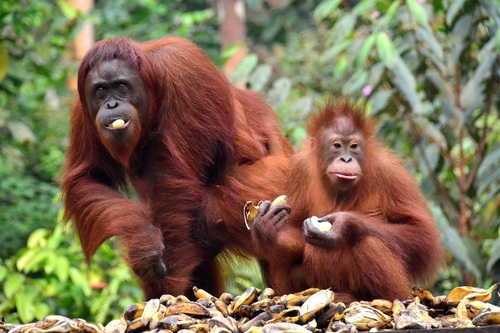
About Pongo pygmaeus (Linnaeus, 1760)
Taxonomic Classification and Size Ranking
The Bornean orangutan, Pongo pygmaeus, is the third-largest ape after the western gorilla, and it is the largest truly arboreal (tree-dwelling) ape that is still alive today. Its body weight range broadly overlaps with that of the considerably taller modern human, although modern humans have far more size variability than the Bornean orangutan.
Size Comparison with Sumatran Orangutan
By comparison, the closely related Sumatran orangutan is similar in overall size but is marginally lighter on average.
Wild Body Size Measurements
A survey of wild Bornean orangutans found that males have an average weight of 75 kg (165 lb), ranging from 50 to 100 kg (110 to 220 lb), and range from 1.2–1.7 m (3 ft 11 in – 5 ft 7 in) in length; females average 38.5 kg (85 lb), with a weight range of 30 to 50 kg (66 to 110 lb) and a length range of 1–1.2 m (3 ft 3 in – 3 ft 11 in).
Captive Body Weight
In captivity, Bornean orangutans can grow considerably overweight, reaching weights of more than 165 kg (364 lb). The heaviest known captive male orangutan was an obese individual named Andy, who weighed 204 kg (450 lb) in 1959 when he was 13 years old.
Body Shape and Limb Structure
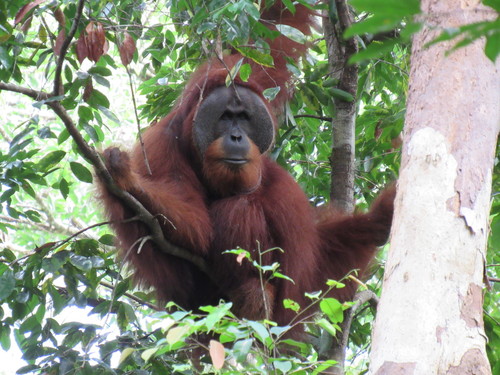
The Bornean orangutan has a distinctive body shape with very long arms that can reach up to 1.5 metres in length. It has grey skin, a coarse shaggy reddish coat, and prehensile, grasping hands and feet.
Facial and Coat Features
Unlike the bodies of most mammals, its coat does not cover its face, though Bornean orangutans do have some facial hair, including a beard and mustache. Mature males also have large fatty cheek pads called flanges, as well as a pendulous throat sac.
Sexual Dimorphism Overview
Bornean orangutans are highly sexually dimorphic, with multiple physical features that differ between males and females. Males have much larger flanges (cheek pads) made of muscle combined with large amounts of fat; in females, flanges are mostly composed of muscle.
Additional Dimorphic Traits
Males also have relatively larger canines and premolars, a more pronounced beard and mustache, and a considerably larger throat sac. Sexually mature males have two distinct body types: smaller and larger.
Male Body Type Dominance
Larger males are more dominant, but smaller males still successfully breed. There is almost no sexual dimorphism in Bornean orangutans at birth.
Elevational Habitat Range
Bornean orangutans currently live in tropical rain forests in the Bornean lowlands, and also in montane rain forests in mountainous areas up to 1,500 m (4,900 ft). This species lives throughout the canopy of both primary and secondary forest, and moves over large distances to find fruit-bearing trees.
Country-level Distribution
It is found in the two Malaysian states of Sabah and Sarawak, and four out of the five Indonesian Provinces of Kalimantan. Due to habitat destruction, the species' current distribution is highly patchy across the island.
Regional Distribution Gaps
The species has become rare in the southeast of Borneo, as well as in the forest between the Rajang River in central Sarawak and the Padas River in western Sabah. Its presence in Brunei is uncertain and unconfirmed.
Pleistocene Fossil Record
The first complete orangutan skeleton discovered was found in Hoa Binh province, Vietnam, and is dated to the late Pleistocene epoch. It differed from modern orangutans only in that its body was proportionately smaller compared to its head.
Historical Continental Range
This fossil, along with other fossils, confirms that orangutans once inhabited continental Southeast Asia; currently, Bornean orangutans are only found in Malaysia and Indonesia. Historically, orangutans ranged throughout Southeast Asia into southern China, as well as on the island of Java and in southern Sumatra.
Primary Habitat Types
Bornean orangutans primarily inhabit peat swamp forest, tropical heath forest, and mixed dipterocarp forest.
Social Solitary Behavior
Bornean orangutans are more solitary than their Sumatran relatives. Two or three orangutans with overlapping territories may interact, but only for short periods of time.
Male Social Behavior
Although orangutans are not territorial, adult males display threatening behaviors when they meet other males, and only socialize with females for the purpose of mating. Males are the most solitary segment of the Bornean orangutan species.
Lifespan
The Bornean orangutan has a wild lifespan of 35–45 years; in captivity it can live to around 60 years of age.
Terrestrial Travel Behavior
Despite being arboreal, the Bornean orangutan travels on the ground more often than its Sumatran counterpart. This may be partially because there are no large terrestrial predators that can threaten orangutans in Borneo, while Sumatran orangutans face predation from the Sumatran tiger.
Nest Building Overview
The Bornean orangutan engages in nest-building behavior. Nests are built for use either at night or during the day.
Nest Building Skill Acquisition
Young orangutans learn nest-building by observing their mothers, and juvenile orangutans practice this skill. Nests can be elaborate, with a foundation and mattress made by intertwining leaves and branches, with additional broken leafy branches added.
Nest Structural Features
Extra features such as shade, a waterproof roof, "pillow", and "blanket", all made from branches, twigs and leaves, may also be added. Nest-building in primates is considered an example of tool use rather than animal architecture.
Other Tool Use Examples
Bornean orangutans have been observed using a range of other tools: they use leaves to wipe off faeces, a pad of leaves to hold spiny durian fruit, a leafy branch as a bee swatter, a bunch of leafy branches held together as an "umbrella" while traveling in the rain, a single stick as a backscratcher, and a branch or tree trunk as a missile.
Mating Interaction Patterns
Males and females of the species generally only come together to mate. Subadult males attempt to mate with any female, and are successful around half the time.
Female Mating Preference
Dominant flanged males call and advertise their position to receptive females, who prefer to mate with flanged males. Adult males often target females with weaned infants as mating partners because these females are likely to be fertile.
Female Reproductive Maturity
Females reach sexual maturity and experience their first ovulatory cycle between about six and 11 years of age; females with more body fat may experience this at an earlier age. The estrous cycle lasts between 22 and 30 days, and menopause has been reported in captive orangutans at around age 48.
Female First Birth Age
Females tend to give birth at around 14–15 years of age.
Newborn Nursing Behavior
Newborn orangutans nurse every three to four hours, and begin to take soft food from their mothers' lips by four months of age. During the first year of its life, the young orangutan clings to its mother's abdomen by entwining its fingers and gripping her hair.
Weaning and Adolescence
Offspring are weaned at about four years, though weaning can take much longer. Soon after weaning, young orangutans enter an adolescent stage where they explore their environment, but always stay within sight of their mother.
Juvenile Independence
During this period, they also actively seek out other young orangutans to play and travel with. On average, juveniles do not become completely independent until they are around seven years of age.
Birth Rate and Habitat Loss
The birth rate for orangutans has been decreasing largely due to a lack of sufficient nutrients resulting from habitat loss. A 2011 study of female orangutans in free-ranging rehabilitation programs found that individuals who received supplementary food resources had shorter interbirth intervals, and a reduced age at first birth.